Showing posts with label Great American Music Hall. Show all posts

Monday, June 1, 2020

5/15/75: the soles of my feet / I swear they're burning

Rick Griffin's proposed but unused LOM logo; courtesy WorthPoint


JGMF recently revisited the 5/21-22/75 Keystone tapes, which I had earmarked as some of the best Legion of Mary shows.  But, like him, a cursory relisten left me a little underwhelmed, in spite of the fantastic quality of the recordings.  So I dug into another old favorite, 5/15/75 at the Great American Music Hall, and was happy to hear that it still held up as a contender for some of the best of LOM.*  The aud tape isn't as special as those Keystone recordings, but it's still a very solid pull by Bob Menke and Louis Falanga, "upfront but not onstage."  The sound is muddier, but also features the full band in a more natural balance, with Kahn's bass cutting through quite nicely in particular.

Garcia seems a little more fired up than usual.  I have had the sense while listening to 74-75 era Garcia/Saunders/LOM that Garcia occasionally sounds like he was -- well, I don't want to say along for the ride, but perhaps not quite as hungry as Fierro or Saunders.  But that is not the case tonight.  When I Die and Every Word You Say are strong but unremarkable warm-up numbers, and the first song that really finds a groove is I Feel Like Dynamite.  Even though Garcia seems to fudge the bridge more often than not, and there's a bit of trainwreck at the end, the energy during his solo is sizzlin' (nice climax!) and the groove is undeniable.  This Wicked Messenger is a rightfully well-known version and is off the charts: this sounds like it was a beast to sing, but the slowed-down arrangement with that monstrous never-ending riff lets Garcia get really down 'n dirty, and his relentless playing here is as nasty as it gets.  Day By Day from the musical/movie Godspell (and a charting single in 1972) is quite a change in mood; this must be from the Aunt Monk songbook, and Garcia doesn't sound super confident with it (this is the first of three four known LOM performances).  It's got a vibe, but to be honest, I am not sorry they didn't develop this one much further. [edit: although I should add that 6/3/75 has some powerful moments].  But it's back to the bakery for a killer Mystery Train, with Tutt* effortlessly nailing down the groove and everyone else in fine style -- they bring the dynamics way down for Garcia's last solo chorus, which is a nice touch.

* big edit: JGMF has raised the question of the drummer's identity, and a minute of reengaging with Mystery Train has me convinced that the drummer tonight is not Ron Tutt.  Tutt always played a very distinctive beat on Mystery Train that emphasized the sixteenth notes on the high-hat (fwiw, this is well-illustrated on 4/6/75, 4/12/75, and 4/20/75, if you'd like to compare), and that is not at all what this drummer is playing.  This drummer also lets Garcia and Kahn establish the tempo and waits a few bars before coming in, which is not what Tutt ever does.  And listen to the "well I went down to the station" breakdown: Tutt always let the dogs out there, whereas this drummer leaves much more space.  And the documentation supports this: Jerrybase notes that both the advertisements and Betty/Rex's tapes list the band as Garcia & Saunders, not Legion of Mary, which is further indication that Tutt was not present, and was not planning to be.  We now return you to this post:

The second set delivers the goods from top to bottom.  I'll Take a Melody is as good as any of these early versions, and You Can Leave Your Hat On cooks up a voodoo soul stew of the highest order; Saunders and Kahn are stirring up something outrageous under Garcia's solo.  I love this one!  Freddie Hubbard's Little Sunflower gets its first of six known LOM airings (it's also on the Aunt Monk w/Garcia 5/9/75 show as well) and Garcia soars on this one, sounding way more on top of things, and gobbles up his two solos.  Neighbor Neighbor is pumping, and Boogie on Reggae Woman ends the set with Saunders and Fierro showing some signs of a long night's work -- but not Garcia, who still sounds rarin' to go.

So: a top-notch Legion of Mary show.  Melody and Wicked Messenger were released on the patchwork Jerry Garcia Collection, Vol. 1: Legion of Mary set, but the whole show (or 5 reels of it anyway) were part of the "third batch" of Bettyboards returned to the vaults, and I would humbly submit this one to the powers-that-be as a good candidate for a full release.

Interesting/frustrating side note: after this show (a Thursday night) the band spent an unusual out-of-town weekend in St. Louis, MO (Friday) and Austin, TX (Saturday-Sunday)... of which no tapes are known to exist.


Tuesday, February 4, 2020

2/5/74: Martin and Martin?

Addendum: OKAY, so six years after posting this, I did a deep dive into all of Garcia/Saunders' performances of My Funny Valentine. What I hear in this version makes me think there's almost no way that Fierro is playing two saxophones by himself.  Listen specifically @16:37 and @21:23, where it sounds like it would have to be two separate saxophonists. I still say, though, that the two saxophone solos over the song's form (not the open-ended jam), which begin at 3:52 and 9:15, both sound like Martin Fierro, and that there are plenty of seemingly spontaneous unison horn lines throughout the show that seem very unusual to have been worked up on the fly.

But hey, when you're wrong, you're wrong!  I am leaving the post intact for the sake of posterity and/or anyone else who wants to dig into this. 
 

A casual listen to Garcia & Saunders at the Great American Music Hall on 2/5/74, to double-check a comment about a mystery guest saxophonist, yielded (of course) a scad of observations that are not quite as coherently unified as I would like.  But such is the practice of observation, I guess.

2/5/74, courtesy gdsets

The recording of this show:

This show (and its neighbor, 2/9/74 at the Rheem Theatre in Moraga, CA) are unusual for being recorded a by taper, Ed Perlstein, who was able to connect his deck to a feed from the soundboard.  He got unplugged at the Rheem, but taped the full show on 2/5.  One drawback of a straight sbd feed is that it's not meant to be heard in isolation, i.e. at home (which is no fault of Mr. Perlstein's, of course): it's a mix for the room that is supplementing the sound coming from the band's gear onstage, so we get very prominent vocals, kickdrum, and saxophone, a little bit of everything else, and less electric guitar, since Garcia's amps tended to be really loud.  At times, his guitar is almost inaudible on this tape, which is not a point in its favor.  The 2/9/74 tape doesn't suffer from this as badly, but it was also a bigger venue (it held 1000; the GAMH held a little more than half that, see below).

The show itself:

is enjoyable, but not one for the ages.  To my ears, 1/17/74 at the Keystone is the one great performance from the first half of the year (which got better as it progressed: see the 6/4-6/6 shows, much of August, and Paul Humphrey's run in October-November).  2/5/74 sounds like it was a fun old night at the office for the band, who play nothing wildly inspired, but are in a nice, loose, happy groove.  I am pretty sure that Billy Kreutzmann is on drums, and he gives everything an ideal swing and pop -- it's always worth highlighting what a great drummer he is, even if he rarely stands out like Paul Humphrey or even Ron Tutt would have.  But check his work on Someday Baby, Roadrunner, It's Too Late: all meat 'n potatoes rhythm & blues, but Billy K puts 'em all right where they should be.  In terms of highlights from Garcia, though, there's not a lot that stands out to my ear.  Tunes that blossomed into more extended vehicles elsewhere are relatively restrained here: La-La, My Problems Got Problems, Wondering Why, Are You Lonely For Me, and so on.  My favorite "jam" here is My Funny Valentine, stretching past 20 minutes and worth every second.

Martin Fierro and the mystery saxophone:

Maybe it's my imagination, but Fierro seems to be given more of the spotlight early in the night: he gets the first solo on the first song, Someday Baby (nice touch to hear Garcia call out "Martin!"), and follows it with La-La, his own composition.  One big mystery of this show -- the reason, actually, that I revisited it -- is that a second saxophone is audible for almost the entire second set, starting at the end of The Harder They Come.  A few mystery trumpet players notwithstanding, I think there is only one other recording of a guest saxophonist from this period: 9/2/74, a baritone sax which might be Snookie Flowers.  What stands out about 2/5 is that this second saxophone doesn't take a single solo, as far as I can tell.  Nearly everything he(?) plays are simple unison lines with Fierro, with pretty close harmonies.  At no point does this second saxophone seem to do anything other than mirror what Fierro is doing: there are some very brief moments in My Funny Valentine and Are You Lonely For Me where the two horns are playing lines that are independent, but otherwise they are in lock-step with each other.  The only times that the second sax disappears is during Wondering Why -- where Fierro plays flute -- or when Fierro is taking a proper sax solo of his own (e.g. Think).

So, I wonder, is this actually a second horn player, or is it all Fierro?  It's not an electronic harmony effect (those exist now, but I don't know if they did in 1974, and Fierro doesn't seem to have used any electronic attachments until later that summer, anyway).  Could he have been playing two horns at once, a la Rahsaan Roland Kirk?  In jazz, that technique is associated almost exclusively with Kirk (who could do it with three), and although many surely dismissed it as a gimmick, it was nevertheless done.  To my knowledge, George Braith was Kirk's only contemporary who regularly used the technique on his recordings, but search Youtube for "two saxophones at once" to see more contemporary examples.  Here is Jeff Coffin (of Bela Fleck & the Flecktones and the Dave Matthews Band) demonstrating how it's done (start at 4:30).

Granted, if this is the case, this would be the only Garcia/Saunders recording where he does this, which would also be pretty strange.  But is it as strange as a second saxophonist playing nearly perfect unison parts with Fierro all night -- but never taking a single solo break -- for just this one performance?  Nothing that both horns plays is in any way complex, mostly just little accompaniment riffs, but it seems far too tight to be just an off-the-cuff guest appearance, and I can't imagine that Fierro and another player would have rehearsed for this.  I can far more easily imagine Fierro playing two horns, then never doing it again after a single raised eyebrow from Garcia, or simply because it was a pain in the ass.

Any thoughts?

[edit: I posted more evidence in the comments.  I'm not going to re-edit this post, though, so see below if you're still not buying it]

[addendum Nov 2024; this occurred to me out of the blue today and I wanted to add it here rather than tuck it away down in the comments]

Further thoughts on why Fierro might have done this just once at this one particular show: consider the sense of occasion.  As outlined below, this show established the GAMH as Garcia's San Francisco room of choice for the next year-and-a-half.  I wonder if it also wasn't something of a debut for Fierro?  Granted, he'd already been playing with the band in a more casual capacity -- he plays on 7/19/73 and 10/2/73 (Winterland) which were both unusual shows with added musical guests; he's on two of the four circulating Keystone shows from Oct-Nov 73 -- but there are plenty more known G/S shows with no tape/setlist, so we don't know how regularly Fierro was present.  On the next available tape, 1/17/74 Keystone, someone in the crowd asks who the sax player is and Garcia introduces him by name.  So it seems safe to assume he may not have been established as a band member yet (or maybe he was and that's just some doof asking what many people already knew?).  So now, on 2/5/74, the band is playing a bigger, fancier space than the Keystone, right in the heart of San Francisco. Maybe no one says so, but maybe the feeling is that something a little special is happening, for Fierro at least. As I said above, Fierro seems to be given more of the spotlight early in the night (Garcia calling him out name as he plays the first solo of the night, then playing his own tune next).  Maybe Fierro figures he'll mark the occasion by trying something a little extra, maybe a tip of the hat to the room's jazz pedigree, and he does the two-horns-at-once thing.  I dunno.  That seems like a thin argument, but it does get at the "why this show and not any other show?" question.


Garcia at the Great American Music Hall:

courtesy gdsets; not much rock & roll!

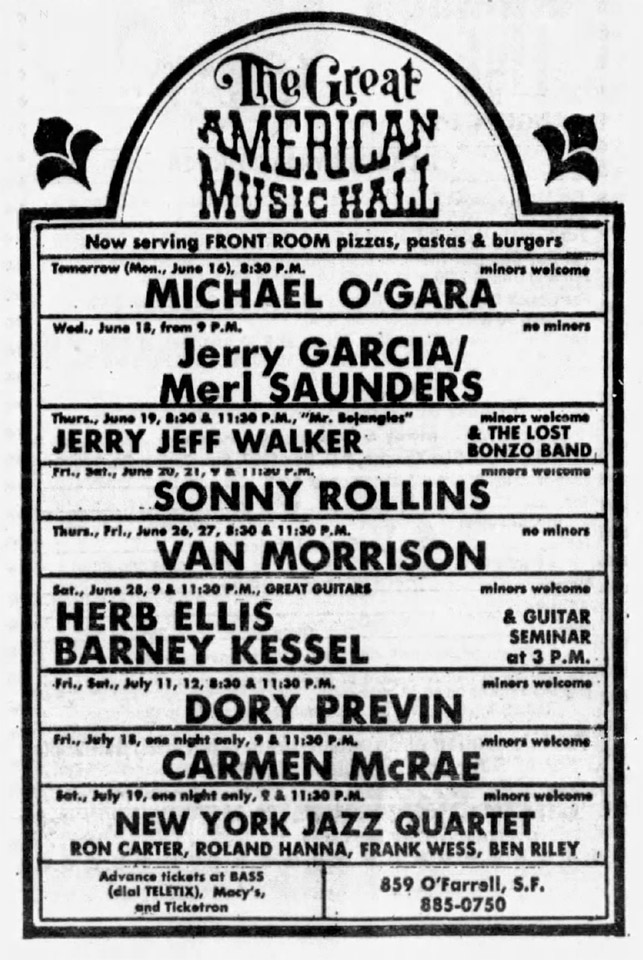
The Keystone in Berkeley is rightfully considered Garcia's homebase in the 70's until the mid-80's, but he also played the Great American Music Hall a lot in 1974.  2/5/74 marked the beginning of a long stretch.  The economic implications of this are more in the JGMF/Lost Live Dead wheelhouse, but it nevertheless strikes me as interesting.  Do we know who was promoting these shows?  I am sure they were happy to fill all those weeknights (see below) with a money maker like Garcia.  The venue was slightly larger -- 600 vs. 475ish at the Keystone  -- and the GAMH appears to have been a much classier joint: it also served food, and the decor was a considerable step up from the Keystone, not to mention that it also sported a pretty colorful history.  The club seemed to book the typically eclectic range of local Bay Area and national acts, but not much in the way of rock & roll.  A few major jazz artists recorded live albums there: Sonny Rollins, McCoy Tyner, Carla Bley, Betty Carter, and Carmen McRae, plus acoustic artists like Doc Watson and David Bromberg.  I am surprised that Old & In the Way never played there.


[edit: Jerrybase has since updated this list, which I will not bother to do myself: see here] 

7/19/73 (Thurs) - the first circulating recording of G/S with Martin Fierro; Fierro said that he first played with Garcia at the Matrix with Howard Wales, but afaik no other evidence exists of that. The first time G/S played the GAMH was a release party for the Fire Up! album, and featured Fierro, Sarah Fulcher, and Matt Kelley all guesting during the 2nd set [partial sbd tape]
2/5/74 (Tues) [sbd tape]
2/12/74 (Tues) [uncirculating Bettyboard, partial?]
3/2/74 (Sat)
3/10/74 (Sun) - David Grisman, Richard Greene & Vassar Clements, with Garcia as guest (no tape); see jgmf
5/2/74 (Thurs)
5/20/74 (Thurs) [uncirculating Bettyboard]

7/14/74 (Sun) - with Stephen Stills and Jack Cassady as guests - see jgmf

7/23/74 (Tues)
8/7/74 (Weds)
8/15/74 (Thurs) [aud tape]
8/24/74 (Sat) [sbd tape]
8/28/74 (Weds) [8 tunes released on the "9/1/74" Pure Jerry set; see jgmf]
10/6/74 (Sun) - with Jim Nelson, drums [partial sbd tape]
10/30/74 (Weds)
11/28/74 (Thurs) [sbd tape]
12/16/74 (Mon)
2/27,28/75 (Thurs, Fri) - the first time billed as the Legion of Mary? [2/28 partial sbd tape]
5/15/75 (Thurs) [aud tape]
6/18/75 (Fri) - billed as Garcia/Saunders, not Legion of Mary [Danny Siewell (of Wings) played drums]. fwiw, I am confident that the tape circulating with this date is actually an aud of 7/4/75.
7/4,5/75 (Fri, Sat) [7/4 sbd tape] (ahem)
7/30/75 (Weds) - maybe, but unlikely? as per jgmf
8/13/75 (Weds) - aka the GD's One From the Vault; see Lost Live Dead
8/20,21/75 (Weds, Thurs) - originally advertised as the Jerry Garcia Band, actually Keith & Donna Band with Jerry as guest [8/20 partial sbd & full aud tape]

unknown (blues?) band, courtesy GAMH via 7x7


Thursday, August 20, 2015

LOM 7/4/75 Great American Music Hall

Man, it's been a nice, long summer, and my work ethic is clearly on vacation.  But I've got some ideas trying to gell into a postable state, and this one was the easiest to wrassle into shape.  I've been on a bit of a Legion of Mary kick (a good soundtrack to match my work ethic) and had been paging through Howard Weiner's new-ish book Positively Garcia.  It's not without its problems, but it's still currently the only book devoted to the non-Dead side of Garcia, and it's also not trying to be any kind of in-depth history: Weiner picks his 13 favorite Garcia shows and reviews them in depth.  He's an early 80's man all the way, and only three 70's shows make the cut: 2/6/72, 6/30/72, and 7/4/75.  The first two get no argument from me, but the '75 pick surprised me (particularly because Weiner doesn't seem to much like Legion of Mary very much in the first place).  I knew it, but hadn't ever given it a critical listen, so what the heck?

a month earlier, in Palo Alto.  Not many LOM pics out there!
We are lucky to have two great sources, a Bettyboard and a fantastic Reinhart Hohlwein aud tape (which sounds like a stage mic recording, like those great Falanga/Menke tapes).  There's also a matrix, but personally I'd go with either of the pure sources in this case (an overview of the different available sources is here).  I listened to the sbd and was most satisfied.

Like most LOM shows, this one has its up and downs, but I do think this is more consistent than most.  The first set starts strong, but doesn't really hit it's stride until midway through.  I'll Take a Melody is a nice opener (it's missing from the sbd, though), then we get a slooow paced Feel Like Dynamite, even slower than most others.  Tutt and Kahn keep it tight and grooving, but it's still really slow and lagging a bit energy-wise.  This kind of deliberate extreme slowness is something I wonder about, but will save for a future post -- I know it's off-putting to many folks, but I'm fascinated by it even when it doesn't particularly work for me.  Someday Baby is one of those tunes that always seems like a good sign: not a staple of the repertoire, and not a real rarity, either, but it seems to me that it tended to make an appearance when Garcia was feeling a little spunky.  Then we get some lift-off: That's All Right Mama wasn't a common LOM tune (only one other version circulates, from two weeks earlier), but this really sizzles: unlike most other Garcia performances, Tutt and Kahn give this one a funkier rhythm, more akin to "That's What Love Will Make You Do," and less of the usual chugging rockabilly "train" rhythm.  Mississippi Moon is a song that I feel was done much better by later Garcia groups, but this one might be the best Saunders-era performance I've heard: it floats along just like it should, and Tutt throws in these nice snare rolls that remind me of Levon Helm on "The Night They Drove Old Dixie Down."  Boogie On Reggae Woman finishes up the set on a high note: unlike Merl's first slowed down selection of the evening, this one is actually played a little more uptempo than usual.  They're cooking now!  I particularly like Martin Fierro's sax solo, which sounds pitched up higher than a tenor sax (he's playing through a Varitone or some other electric effect, I think; I'm pretty sure it's Fierro and not a guest).  The saxophone is another thing some folks don't appreciate about this era of Garcia, but I think Fierro was usually a good stylistic fit, and this is an A+ example of that.  It sounds like we lose a chunk of Saunders' solo in a reel flip, but this is still a top drawer version of BORW before Garcia announces the break.

Tough Mama splices in to begin the second set and things are still riding high: this version was released on the Legion of Mary official release, and I'd be hard pressed to find a better one (though TM fans should check the "4/12/75 early show" version, too).  Little Sunflower is good, but not great; I appreciate the diverse nature of this group, but I don't think jazz was really their strong suit.  Tutt and Kahn could really work wonders as a rhythm section, but not always on the jazz material.  This one, at least, finds a groove and floats along pleasantly, so no complaints.  Garcia gets everyone's priorities back in order with a strong Tore Up Over You, breaking out his slide for a little bottleneck action near the end that sounds pretty strong; then he eases back into a wonderful Every Word You Say, really shooting flames in that excellent final solo.  Merl's My Problems Got Problems is a solid one, not quite stirring up the the voodoo soul stew like the best 74-75 versions, but plenty satisfying.  I've never been a huge fan of It's Too Late but Garcia breaks out the slide once again and this one may be as good as they got on this tune.  Similarly, I also don't have a lot of love for these Tutt-era Harder They Comes, which tend to plod along and never get off the ground.  As tight as they are tonight, this one didn't feel much different -- it's a little bit of an anticlimax, perhaps, but they do kick up the energy for a flashy loud finish, which I appreciate.

Ups, downs, definitely more than just another night at the office for this band, but I don't know that it makes it into my own imaginary list of the greats.  For my money, Legion of Mary doesn't get much better than 5/21/75, and 5/15/75 is up there as well.  Still, 7/4/75 is a strong one and it's held up to a few repeat listens over the past few days.  Unfortunately, this July 4th weekend run of shows (the 4th, 5th, and 6th) was also the last stand for this group: Saunders and Fierro were left aside, apparently with little warning or explanation, and Garcia, Kahn, and Tutt began the first official Jerry Garcia Band a few months later.  This has always been a blurry spot in Garcia's history (and not one that reflects well on Garcia), but from a musical standpoint I think it makes a good amount of sense: without speculating too much, I don't think it's a stretch to presume that lumbering funk jams and jazz tunes weren't what Garcia wanted to play anymore, and I suspect he didn't see the band as ever going in a substantially different direction.  Weiner asserts in his book that Saunders' tunes don't "successfully co-exist" with Garcia's, and that Saunders and Fierro hold back the x-factor that flows freely whenever Garcia steps up for a solo.  I don't buy that explanation myself: there are nights, particularly in some of the fall '74 Garcia/Saunders shows, where Saunders and Fierro are totally on it while Garcia seems like he's treading water, and I tend to side more with the JGMF school of thought that Garcia playing challenging and unusual material tended to bring out more positive dimensions to his playing.  On the other hand, it could feel at times like Garcia was more like a sideman in the Saunders/Fierro band, though, and I can see why that would have naturally ran its course.  Other reasons (economic ones certainly) certainly came into play, but I don't see much mystery in why Garcia parted company from Saunders for the time being.  They did go out on a high note, at least.


Some final thoughts:

Check your hard drives and see if you agree, but I think the fileset circulating as 6/18/75 is a duplicate of this show: it's a different, lower quality aud recording and is clearly incomplete, but what's there sounds identical to the 7/4/75 performances, minus the instrumentals.

Amazingly, Garcia played the GAMH 30 times between 1973-1976.  Corry at lostlivedead did an excellent post on the Dead's famous 8/13/75 Great American Music Hall show, with some excellent background color on the venue:
http://lostlivedead.blogspot.com/2014/08/august-13-1975-great-american-music.html

Also, during this same 4th of July weekend, Bob Marley was playing only a few blocks away at the Boarding House, with an additional show on Monday the 7th (broadcast on KSAN, circulating widely, and currently available here if you're interested).  We have tapes dated July 7 of the Dead working at Weir's studio -- I wonder if Garcia & co. crept on down to the Boarding House afterwards to, um, let off some smoke after a busy few days? (figuratively speaking, obviously) [addendum: Merl had worked with Bob Marley on Taj Mahal's Mo Roots album in 1974; Merl Jr says in his liner notes to GarciaLive Vol 9 that Marley produced the tracks Merl played on]