Showing posts with label Legion of Mary. Show all posts

Monday, March 21, 2022

Legion of Mary: never meant to last? (duh?)

The New York Times reported, on April 4, 1975, on the Legion of Mary's arrival in New York:

[Garcia's and Saunders's] current quintet... is fixed enough to be considered a real unit, Mr. Garcia reported the other day from San Francisco.

Mr. Garcia is very pleased by the quality of the current group. “We're more on the relaxed than the hurried side of the metronome,” he said. “We get a real nice conversational quality in our music.”

The East Coast swing lasts only three weeks, but Mr. Garcia said that Legion of Mary would make a longer tour later on, and that there are “tentative plans” for a record.
 

Almost a year later to the day (April 1, 1976), Garcia gave an interview to The Music Gig magazine:

Garcia's association with Merle Saunders last year [1975] produced many a sloppy concert and severely tested the endurance of the audience. "Yeah, we burned out on it too," he allows. "That was a very weird band it was never meant to go out and tour" [sic].

(note that this 1976 interview is the same one where Garcia praises the JGB's harmonious consonance, as opposed to the Dead's dissonance and divergent viewpoints)


No big revelations here, I guess?  The breakup of the Legion of Mary and the larger Garcia/Saunders partnership is still foggy (see JGMF on the precise-ish dating of their split and other thoughts), and it seems likely that the principals wouldn't necessarily agree on the real reason, even if we had firm statements on the record, which we mostly do not.  I don't see any real mystery: it had run its course, and Garcia wasn't interested in moving further with a band that played this particular hodgepodge of music: contemporary soul and funk, extended jazz instrumentals, and Garcia's own bag of favored Americana.  The comment about it being a band that "was never meant to go out and tour" belies his earlier 1975 plug for more touring and a record, but it is still probably true in the grander scheme of things: ultimately, it was the club band that was meant to work late at night in laid back local haunts, not up on big stages to crowds of hollering fans coast to coast.  It seems impossible to overstate the influence that Saunders had on his playing, and Garcia clearly had a great time working out on some unfamiliar material (that eventually became familiar and then, maybe, overfamiliar) in his downtime away from the dissonance of the Grateful Dead.  But that's not the same as making it a thing, as the kids say -- touring around, making records, all the attendant hassles.  Keeping with that old wife/mistress metaphor (used by Garcia himself, somewhere), I wonder if the Legion of Mary wasn't the mistress that started making more serious moves into the master bedroom after the wife left town for a bit.

Obviously Saunders and Fierro wouldn't have seen it that way, and to be honest, one thing I enjoy about all their music from 1974-75 is that Garcia isn't always the most comfortable sounding guy onstage, and that there are times when Fierro and Saunders just smoke him.  But no mystery why Garcia would at some point want to put that down, particularly when it became the Main Event.

But I do have to snicker at the idea that the JGB ca 1976 didn't indulge in a little bit of "severely testing the endurance of the audience" of its own (exhibit A).


Rockwell, John.  "The Pop Life."  The New York Times, April 4, 1975.  Online. 

Weitzman, Steve.  (unknown title).  The Music Gig, Aug 1976.
(clipping saved in Dick Latvala's scrapbook, Book 1, p. 31.  A later revision of this piece -- without this quote -- is at Dead Sources)


Monday, June 1, 2020

5/15/75: the soles of my feet / I swear they're burning

Rick Griffin's proposed but unused LOM logo; courtesy WorthPoint


JGMF recently revisited the 5/21-22/75 Keystone tapes, which I had earmarked as some of the best Legion of Mary shows.  But, like him, a cursory relisten left me a little underwhelmed, in spite of the fantastic quality of the recordings.  So I dug into another old favorite, 5/15/75 at the Great American Music Hall, and was happy to hear that it still held up as a contender for some of the best of LOM.*  The aud tape isn't as special as those Keystone recordings, but it's still a very solid pull by Bob Menke and Louis Falanga, "upfront but not onstage."  The sound is muddier, but also features the full band in a more natural balance, with Kahn's bass cutting through quite nicely in particular.

Garcia seems a little more fired up than usual.  I have had the sense while listening to 74-75 era Garcia/Saunders/LOM that Garcia occasionally sounds like he was -- well, I don't want to say along for the ride, but perhaps not quite as hungry as Fierro or Saunders.  But that is not the case tonight.  When I Die and Every Word You Say are strong but unremarkable warm-up numbers, and the first song that really finds a groove is I Feel Like Dynamite.  Even though Garcia seems to fudge the bridge more often than not, and there's a bit of trainwreck at the end, the energy during his solo is sizzlin' (nice climax!) and the groove is undeniable.  This Wicked Messenger is a rightfully well-known version and is off the charts: this sounds like it was a beast to sing, but the slowed-down arrangement with that monstrous never-ending riff lets Garcia get really down 'n dirty, and his relentless playing here is as nasty as it gets.  Day By Day from the musical/movie Godspell (and a charting single in 1972) is quite a change in mood; this must be from the Aunt Monk songbook, and Garcia doesn't sound super confident with it (this is the first of three four known LOM performances).  It's got a vibe, but to be honest, I am not sorry they didn't develop this one much further. [edit: although I should add that 6/3/75 has some powerful moments].  But it's back to the bakery for a killer Mystery Train, with Tutt* effortlessly nailing down the groove and everyone else in fine style -- they bring the dynamics way down for Garcia's last solo chorus, which is a nice touch.

* big edit: JGMF has raised the question of the drummer's identity, and a minute of reengaging with Mystery Train has me convinced that the drummer tonight is not Ron Tutt.  Tutt always played a very distinctive beat on Mystery Train that emphasized the sixteenth notes on the high-hat (fwiw, this is well-illustrated on 4/6/75, 4/12/75, and 4/20/75, if you'd like to compare), and that is not at all what this drummer is playing.  This drummer also lets Garcia and Kahn establish the tempo and waits a few bars before coming in, which is not what Tutt ever does.  And listen to the "well I went down to the station" breakdown: Tutt always let the dogs out there, whereas this drummer leaves much more space.  And the documentation supports this: Jerrybase notes that both the advertisements and Betty/Rex's tapes list the band as Garcia & Saunders, not Legion of Mary, which is further indication that Tutt was not present, and was not planning to be.  We now return you to this post:

The second set delivers the goods from top to bottom.  I'll Take a Melody is as good as any of these early versions, and You Can Leave Your Hat On cooks up a voodoo soul stew of the highest order; Saunders and Kahn are stirring up something outrageous under Garcia's solo.  I love this one!  Freddie Hubbard's Little Sunflower gets its first of six known LOM airings (it's also on the Aunt Monk w/Garcia 5/9/75 show as well) and Garcia soars on this one, sounding way more on top of things, and gobbles up his two solos.  Neighbor Neighbor is pumping, and Boogie on Reggae Woman ends the set with Saunders and Fierro showing some signs of a long night's work -- but not Garcia, who still sounds rarin' to go.

So: a top-notch Legion of Mary show.  Melody and Wicked Messenger were released on the patchwork Jerry Garcia Collection, Vol. 1: Legion of Mary set, but the whole show (or 5 reels of it anyway) were part of the "third batch" of Bettyboards returned to the vaults, and I would humbly submit this one to the powers-that-be as a good candidate for a full release.

Interesting/frustrating side note: after this show (a Thursday night) the band spent an unusual out-of-town weekend in St. Louis, MO (Friday) and Austin, TX (Saturday-Sunday)... of which no tapes are known to exist.


Thursday, December 17, 2015

I'll Take a Melody

I was listening to a little Allen Toussaint playlist I made for myself and the original(?) recording of "I'll Take a Melody" came on, sung by Frankie Miller on his 1974 album Frankie Miller's High Life (groan), which Toussaint produced, arranged, and wrote the bulk of the material for.

It's a great song, and one of the many things I like about it is that it slyly makes reference to its own chord progression -- "I'll take a melody and see what I can do about it / I'll take a simple C to G and feel brand new about it" -- a small testament to Toussaint's cleverness as a songwriter.  My discographically sensitive brain is drawing a blank on other song lyrics that refer to their own chords [edit: got one! "Hallelujah" by Leonard Cohen], but it's not exactly a common songwriting device.  Given that, it was always a tad disappointing to me that the chords aren't actually C or G: the verse and chorus are an A, D, E.  Just now, however, I noticed that the Frankie Miller version has the line: "I'll take a simple D to E and feel brand new about it."  Hmm.  Given that Garcia was singing the lyric and playing the chords, you would think he'd have noticed.  I wonder what was up with that?  Maybe his poet's ear was pleased more by the consonance of "see what I can do ... simple C to G" than the clunkier sounding "simple D to E"?

The other slight lyric change that I'd never noticed before was that Garcia sings "I understand why the old fisherman sail along, sail along [etc] / someday he'll be gone," while Miller sings it, "someday you'll be gone."  I'm not sure which one I like more, but both are appealingly opaque.

Thursday, August 20, 2015

LOM 7/4/75 Great American Music Hall

Man, it's been a nice, long summer, and my work ethic is clearly on vacation.  But I've got some ideas trying to gell into a postable state, and this one was the easiest to wrassle into shape.  I've been on a bit of a Legion of Mary kick (a good soundtrack to match my work ethic) and had been paging through Howard Weiner's new-ish book Positively Garcia.  It's not without its problems, but it's still currently the only book devoted to the non-Dead side of Garcia, and it's also not trying to be any kind of in-depth history: Weiner picks his 13 favorite Garcia shows and reviews them in depth.  He's an early 80's man all the way, and only three 70's shows make the cut: 2/6/72, 6/30/72, and 7/4/75.  The first two get no argument from me, but the '75 pick surprised me (particularly because Weiner doesn't seem to much like Legion of Mary very much in the first place).  I knew it, but hadn't ever given it a critical listen, so what the heck?
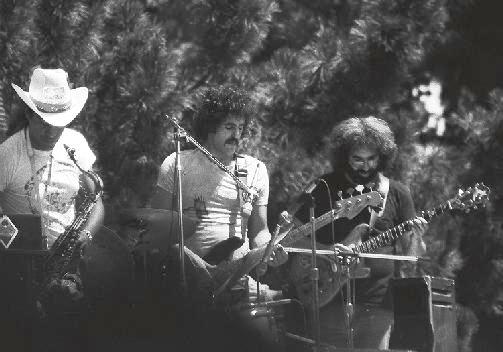
a month earlier, in Palo Alto.  Not many LOM pics out there!
We are lucky to have two great sources, a Bettyboard and a fantastic Reinhart Hohlwein aud tape (which sounds like a stage mic recording, like those great Falanga/Menke tapes).  There's also a matrix, but personally I'd go with either of the pure sources in this case (an overview of the different available sources is here).  I listened to the sbd and was most satisfied.

Like most LOM shows, this one has its up and downs, but I do think this is more consistent than most.  The first set starts strong, but doesn't really hit it's stride until midway through.  I'll Take a Melody is a nice opener (it's missing from the sbd, though), then we get a slooow paced Feel Like Dynamite, even slower than most others.  Tutt and Kahn keep it tight and grooving, but it's still really slow and lagging a bit energy-wise.  This kind of deliberate extreme slowness is something I wonder about, but will save for a future post -- I know it's off-putting to many folks, but I'm fascinated by it even when it doesn't particularly work for me.  Someday Baby is one of those tunes that always seems like a good sign: not a staple of the repertoire, and not a real rarity, either, but it seems to me that it tended to make an appearance when Garcia was feeling a little spunky.  Then we get some lift-off: That's All Right Mama wasn't a common LOM tune (only one other version circulates, from two weeks earlier), but this really sizzles: unlike most other Garcia performances, Tutt and Kahn give this one a funkier rhythm, more akin to "That's What Love Will Make You Do," and less of the usual chugging rockabilly "train" rhythm.  Mississippi Moon is a song that I feel was done much better by later Garcia groups, but this one might be the best Saunders-era performance I've heard: it floats along just like it should, and Tutt throws in these nice snare rolls that remind me of Levon Helm on "The Night They Drove Old Dixie Down."  Boogie On Reggae Woman finishes up the set on a high note: unlike Merl's first slowed down selection of the evening, this one is actually played a little more uptempo than usual.  They're cooking now!  I particularly like Martin Fierro's sax solo, which sounds pitched up higher than a tenor sax (he's playing through a Varitone or some other electric effect, I think; I'm pretty sure it's Fierro and not a guest).  The saxophone is another thing some folks don't appreciate about this era of Garcia, but I think Fierro was usually a good stylistic fit, and this is an A+ example of that.  It sounds like we lose a chunk of Saunders' solo in a reel flip, but this is still a top drawer version of BORW before Garcia announces the break.

Tough Mama splices in to begin the second set and things are still riding high: this version was released on the Legion of Mary official release, and I'd be hard pressed to find a better one (though TM fans should check the "4/12/75 early show" version, too).  Little Sunflower is good, but not great; I appreciate the diverse nature of this group, but I don't think jazz was really their strong suit.  Tutt and Kahn could really work wonders as a rhythm section, but not always on the jazz material.  This one, at least, finds a groove and floats along pleasantly, so no complaints.  Garcia gets everyone's priorities back in order with a strong Tore Up Over You, breaking out his slide for a little bottleneck action near the end that sounds pretty strong; then he eases back into a wonderful Every Word You Say, really shooting flames in that excellent final solo.  Merl's My Problems Got Problems is a solid one, not quite stirring up the the voodoo soul stew like the best 74-75 versions, but plenty satisfying.  I've never been a huge fan of It's Too Late but Garcia breaks out the slide once again and this one may be as good as they got on this tune.  Similarly, I also don't have a lot of love for these Tutt-era Harder They Comes, which tend to plod along and never get off the ground.  As tight as they are tonight, this one didn't feel much different -- it's a little bit of an anticlimax, perhaps, but they do kick up the energy for a flashy loud finish, which I appreciate.

Ups, downs, definitely more than just another night at the office for this band, but I don't know that it makes it into my own imaginary list of the greats.  For my money, Legion of Mary doesn't get much better than 5/21/75, and 5/15/75 is up there as well.  Still, 7/4/75 is a strong one and it's held up to a few repeat listens over the past few days.  Unfortunately, this July 4th weekend run of shows (the 4th, 5th, and 6th) was also the last stand for this group: Saunders and Fierro were left aside, apparently with little warning or explanation, and Garcia, Kahn, and Tutt began the first official Jerry Garcia Band a few months later.  This has always been a blurry spot in Garcia's history (and not one that reflects well on Garcia), but from a musical standpoint I think it makes a good amount of sense: without speculating too much, I don't think it's a stretch to presume that lumbering funk jams and jazz tunes weren't what Garcia wanted to play anymore, and I suspect he didn't see the band as ever going in a substantially different direction.  Weiner asserts in his book that Saunders' tunes don't "successfully co-exist" with Garcia's, and that Saunders and Fierro hold back the x-factor that flows freely whenever Garcia steps up for a solo.  I don't buy that explanation myself: there are nights, particularly in some of the fall '74 Garcia/Saunders shows, where Saunders and Fierro are totally on it while Garcia seems like he's treading water, and I tend to side more with the JGMF school of thought that Garcia playing challenging and unusual material tended to bring out more positive dimensions to his playing.  On the other hand, it could feel at times like Garcia was more like a sideman in the Saunders/Fierro band, though, and I can see why that would have naturally ran its course.  Other reasons (economic ones certainly) certainly came into play, but I don't see much mystery in why Garcia parted company from Saunders for the time being.  They did go out on a high note, at least.


Some final thoughts:

Check your hard drives and see if you agree, but I think the fileset circulating as 6/18/75 is a duplicate of this show: it's a different, lower quality aud recording and is clearly incomplete, but what's there sounds identical to the 7/4/75 performances, minus the instrumentals.

Amazingly, Garcia played the GAMH 30 times between 1973-1976.  Corry at lostlivedead did an excellent post on the Dead's famous 8/13/75 Great American Music Hall show, with some excellent background color on the venue:
http://lostlivedead.blogspot.com/2014/08/august-13-1975-great-american-music.html

Also, during this same 4th of July weekend, Bob Marley was playing only a few blocks away at the Boarding House, with an additional show on Monday the 7th (broadcast on KSAN, circulating widely, and currently available here if you're interested).  We have tapes dated July 7 of the Dead working at Weir's studio -- I wonder if Garcia & co. crept on down to the Boarding House afterwards to, um, let off some smoke after a busy few days? (figuratively speaking, obviously) [addendum: Merl had worked with Bob Marley on Taj Mahal's Mo Roots album in 1974; Merl Jr says in his liner notes to GarciaLive Vol 9 that Marley produced the tracks Merl played on]