Monday, March 30, 2020

2/14/75: as sweet as a love note

Aunt Monk, 1975, courtesy bay-area-bands.com

No deep dive here, but I wanted to see how this next show compared with the previous ones: this is one of two circulating Aunt Monk gigs with Garcia sitting in.  Even though it's fully Merl's gig, Garcia is as prominent as he is on Garcia/Saunders shows, right down to the same typical order of solos (Fierro, Garcia, Saunders, and usually Garcia again).  JGMF has some context re: Aunt Monk in his post on the other circulating Generosity show.

In the interest of relative brevity:
  • This is a lovely quality aud by Robert Castelli.  I am eternally grateful for his work here.  It's a little muffled, comparatively speaking, but with no crowd interference and excellent clarity, and I quite like the feel of it.  There's a nice moment of color just as the music is beginning when a female right next to him says, "just keep it low!" (the mics? the bowl?) and laughs.
  • The Generosity was... a bar?  I am not finding any info.  But it was probably tiny.  There are no vocals, so maybe there wasn't even a PA system, and Merl only plays electric piano here, taking up far less space than a full Hammond B3 + Leslie speaker.
  • This show is on par with the Jan 75 Keystone shows in terms of quality, although I personally prefer what Gaylord Birch brought to the mix at those shows.  But ye gods, they just bite down hard on just about everything here.  Merl's rarely played (as far as we know) original A Little Bit of Righteousness gets a high spirited run-through with the rhythm section lifting them all a few feet off the ground.
  • Pennies From Heaven again!  The drummer, Bob Stellar, gives this more a straight-down-the-middle beat like a 6/8 R&B ballad.  Garcia is all over it and sounds more comfortable here than on 1/21/75, imho.  Incredible.
  • When I Die also has a different feel than the Jan 75 versions, again largely due to Stellar at first.  But both Garcia and Saunders sound noticeably edgier in their attack here, and they're really both going off by the end of this.  Wow!  
  • The most magical moment of the set, to my ears, is the verrry extended treatment of People Make the World Go Round, which Garcia/Saunders played only as a shorter instrumental without any solos, more like a kind of coda to another instrumental.  This one goes for 21 1/2 minutes, and the playing is the most interactive and "jammy" of the night.  There are still solos, but they seem to blend into each other more freely and there's a lot more interplay between Garcia, Fierro, and Saunders than in most other songs.  You'll have to hear it to believe it.
  • Stevie Wonder's Creepin' sounds like it might be a new number for them (it's not an easy tune!), but Garcia does not sound like the weakest link.  He eats it up, and iirc this is better than any of the few later Legion of Mary versions.
  • This show was Merl's 41st birthday.  Garcia was 32 and Fierro had just turned 33.

Simply amazing that this happened, that it sounds so goddamn good, and that we have a tape of it.

Tuesday, March 24, 2020

Jan 21-22, 1975 - or, the case of "7/21-22/74"

Some years ago I came to the conclusion that the Garcia/Saunders tapes (er, filesets) labeled as 7/21/74 and 7/22/74 were mixed up and mislabeled -- it was pretty obvious that what circulates as 7/21/74 couldn't be from one show.  I did some close listening to where the tape cuts were and came up with a convincing reassembly of these fragments that made more sense.  I can't think of another way to reassemble these fragments that would work, so I just went ahead and reordered/retagged them and have been listening to my own modified version for a while, so I figured I would expand my usual listening notes with the full argument.  JGMF has covered the unlikeliness of the tapes really being from 7/21 & 7/22/74, and it seems far more likely that the real dates are 1/21 & 1/22/75 at the Keystone in Berkeley.  JGMF has also confirmed that the lineup on these nights was unusual: Tony Saunders on bass (all of 19 years old, I believe) and Gaylord Birch on drums, in addition to Martin Fierro, Merl Saunders, and Jerry Garcia. 

Tony Saunders, from the back cover collage on Merl's s/t 1974 album

The music on these tapes is phenomenal and, in a few instances, utterly unique, and I believe that the confused presentation of these filesets has caused this music to be overlooked by all but the most fervent Garcia fan (no knock on anyone who was part of the distribution chain of these tapes, of course).  Maybe you are someone who hasn't given them close attention for this very reason.  If that describes you, dear reader, then read on and listen anew and be wowed.

In the interest of saving the fine print until the end, I will dive into the music first and assume you're willing to buy my reasoning re: the dating and organizing of this music as closer to what was actually played. 

On a contextual note: it is established that,
  • Ron Tutt joined the band in December 1974, prompting the formal name change to Legion of Mary several months later.  Even after LOM was formalized as a band, there were still occasional local listings for "Garcia & Saunders" gigs.  This meant that Tutt was not present for whatever reason (more info; there was no Elvis conflict in Jan 1975, fwiw).
  • In 1974-75, Merl Saunders was performing concurrently with his own band, Aunt Monk, including Tony on bass and Martin Fierro on sax.  Garcia would occasionally show up at these shows as well, playing material both familiar and unfamiliar to him from the Garcia/Saunders repertoire (more info).
  • Despite being two separate bands, there was the occasional overlapping of personnel between Garcia/Saunders and Saunders' own gigs.  One such overlap were three remarkable shows in June 1974 where Tony replaced John Kahn on bass, which I have covered here.  
  • The musicians and repertoire on these tapes in question seem to live right in the middle of the venn diagram of Garcia/Saunders and Aunt Monk.


 courtesy JGMF (surprise!)


 1/21/75


The Harder They Come - very fine, with an excellent groove and feel, especially compared with many 1974-75 performances that I often find more plodding.  Interestingly, it sounds like Fierro is playing his usual tenor with lots of wahwah during the song itself, but soloing on a higher-pitched horn (a soprano maybe?  I am sure it's him and not a guest, and you can hear him fiddling with his tenor again shortly after his solo is over).  After a high energy finish, Jerry announces the set break.

When I Die - the reel cuts in at the beginning.  This is funky!  and arguably one of the best of the versions that we have (at least until the next night!).  Merl & Tony play a cool little rhythmic figure that they keep up throughout most of the solos, and Birch absolutely nails this.  There's a snafu near the end when Merl finishes his solo and Garcia jumps back in, not hearing that Merl has transitioned back into the bridge of the song.  No harm done.  Afterwards, someone (either Tony or Birch?) laughs, "whoo! yeah, Jerry! what's up!"  Garcia noodles around a bit and someone asks,"wanna do it? you gonna do it?" which prompts:

Pennies From Heaven
- They shift gears into classic organ combo mode for Garcia to serenade this standard from the 30's that is probably associated with Louis Armstrong as much as anyone else, although Garcia's idol Django Reinhardt is among the many who also recorded it.  There are plenty of examples of Garcia hanging with Saunders on jazz material that was not his typical forte, but it's amazing to hear him taking the lead here in digging into a standard like this!  He's clearly having a blast, even if he's chewing the scenery just a little bit.  Fierro solos next, then another quick chorus from Garcia, then Merl.  Just as his solo is ending, the reel cuts off and cuts back in as they go into the head of the song, with very little missing.  It sounds like folks are patting Garcia on the back when they're done: Merl says, "that's good!" and someone else adds, "that's all right!"   [edit 2025: Legion of Mary also played Pennies From Heaven on 2/28/75! please oh please, someone circulate this tape!]  Then Garcia suggests, "we could do Reggae Woman."

Boogie On Reggae Woman - Excellent again.  At this point, there were only a small number of performances of this on tape (it became a staple for LOM in 1975), but they are all on top of it tonight.  Check out after the last verse how they keep it going a little longer, verrry quietly.  Nice touch!

Some inaudible off-mic talk follows.  After Midnight and Mystery Train are mentioned.  Merl and Tony play with the beginning of Creepin' (Stevie Wonder), until Merl suggests, "why don't we just - you wanna do Wonderin'?  Wonderin' Why?"

Wonderin' Why - sounds wonderful, if not all that different from many other wonderful versions.  Then Garcia counts right into a stompin' How Sweet It Is.  This one is interrupted by another reel flip, missing a bigger chunk of music this time.  He says good night, and the crowd sounds particularly appreciative and vocal with their thanks.

Well then.  This was amazing.  Top drawer Garcia/Saunders, in outstanding Bettyboard sound.  What could be better?  Glad you asked:


1/22/75

After Midnight - this cuts in at the peak of Fierro's solo, so watch your eardrums.  But it's really hot!  High temperature stuff.  Afterwards - Jerry: "You wouldn't happen to have any matches, do you? ... but don't even worry, don't worry about it."   Then, a guy in the crowd: "Jerry, want a hit, man?"  Jerry: "Do I want a hit, man?  No thank you, I just had one."  Classic.  Merl calls the next tune.

When I Die - Betty's mix is a little hot, but so is the playing.  As hot the last version was, this one is even better and also a few minutes longer.  My goodness.  This time, rather than jump right into the bridge out of Merl's final solo, they opt to keep jamming loosely for a little bit before wrapping things up.  What a version!  C'mon, deadheads, you all need to hear this.

You Can Leave Your Hat On - this takes things down a notch, perhaps inevitably given how high energy the first two songs were.  But it ain't bad at all!  There's another small reel flip in this one.  Notice how during Merl's solo (after the flip), Garcia is messing around a bit with playing octaves a la Wes Montgomery, something that he did occasionally in early 75 and another clue as to the dating of this tape.  Afterwards, someone says "we can only do one more" and Garcia counts off

That's What Love Will Make You Do - Birch's beat here is distinctive from other 74-75 versions and this feels a little stiff at first, but they loosen up as the solos gain momentum.  Garcia's guitar volume drops @4:23, and I wonder if he blew a tube or something else, but he plays on without a hiccup.  Nice near miss @11:02 when he catches them by surprise by repeating the "when you speak of beauty" break, but whoa, they all nail it anyway!  Amazing.  "We're gonna take a break, we'll be back pretty soon."

Cucumber Slumber - the first of two tunes unique to this show.  The oft-repeated story behind Weather Report's Cucumber Slumber is that bassist Alphonso Johnson came up with its classic bassline in the studio and the tune was a spontaneous jam (although the album track is actually a second take made after some evident arrangement, including a melody played in unison by the sax and keyboards; lots of info here) .  The song moves back and forth between two distinct sections, one in Db7 (the band is playing this section as the album track fades in) and one in E7 (with Johnson's famous bassline), with a transition between the two.  Weather Report spends more time jamming in the Db7 section, although the E7 section is probably what most listeners remembers about the song.  If you want a more technical explication, see Mark Frandsen's analysis in his dissertation on Weather Report's bass players (which clarified all this info for me).

Tony commented at etree, "that was a song we played with Aunt Monk and Jerry liked it so we played it together."  Their arrangement is looser and emphasizes the E7 section almost entirely, with Tony holding on to that bassline for all its worth.  Like Weather Report, they begin playing in Db7 briefly (it sounds maybe like Fierro is alluding to Weather Report's melody, though they never play it), but once they get into the E7 section, they stay there for a long time: both Fierro and Garcia solo, and when Merl's turn comes, he leads everyone into the Db7 section briefly (this is around 9:15) and then back into E7 for his extended solo, and then another turn for Garcia.  During Garcia's second solo, things get looser and the playing becomes more interactive and "jammy" (Tony abandons the bassline for a little while as well).  They shift back to the Db7 section in the final few minutes, and wrap it up by playing the transition figure at the end.  Wow!  Given that they're mostly jamming out on one chord, everyone has plenty of room to flex and they all sound comfortable digging in. 

The Harder They Come - a little looser in spots, but this is still great and like When I Die from this show, it sounds like they're pushing a bit further than the prior version.  Check out how they get real quiet at 12:16 for the end of Garcia's solo -- he's playing the melody and Martin creates a guitar-like effect by tapping the keys of his horn while working the wahwah, which leads right back into the vocals.  Very cool, and something I don't recalls ever hearing in THTC before.

What's Going On
- the second unique song.  I'm sure plenty of folks with gigs like Merl's were playing this tune in the early 70's; one way to approach it was to have everyone solo over the form of the entire song, like this version by organist Johnny Hammond Smith.  But Merl also must have heard Donny Hathaway's incredible live version which features both vocals and a keyboard solo over just the instrumental bridge of the song.  Notably, Hathaway also made a minor but pretty hip adjustment to this part by adding some additional changes (hear it in his solo).  Merl opts to have it both ways: Fierro plays the tune on flute, and then he, Garcia, and Merl take a turn soloing over the entire song form, which imho makes for some unavoidably long-winded solos.  Everything glides along well enough but a bit sloppily, with the tempo wavering and speeding up as it goes.  But after Merl's solo ends (at 16:20 into the song) he shifts gears and solos again, this time just over the instrumental bridge, like in Hathaway's version.  Everyone goes for another round of solos, but now it sounds like they're finally taking flight, since no one has to follow the contours of the actual song and can just dig in and blow.  The cut at the end is negligible, just a fraction of a second.  Wow!  Overall it's a little shaky, but is redeemed by the funkier second half.  And given what a unique performance this is, it's hard to be too critical. 

How Sweet It Is - another high-energy set closer, with no cut this time.  The last 50 seconds of dead air as they break down is a nice touch: "awright, Jerry, cut that shit out!"

I am out of superlatives.   Much like the June 74 shows with Tony, these performances are both unique and, despite a few looser-than-usual moments, feature some incredibly high caliber playing.  Mid 70's solo Jerry doesn't get much better than this, and if you haven't spent time getting up close and personal with these tapes, you really should.


THE RATIONALE

If you've made it this far, I am sure you cannot wait to hear how I came up with this order for the songs.  These are the digital filesets for these tapes as they circulate:

"7/21/74" = jg1974-07-21.jgms.93mins.sbd-Betty.117653.flac1644
"7/22/74" = jg1974-07-22.jgms.146mins.sbd-GMB.86198.flac1644

And if you split the filesets into reels, based on the tape breaks (the tape runs continuously between songs unless noted), you get this:

7/21/74 d1t01 [18:24] Harder They Come > "we're gonna take a break"
7/21/74 d1t02 [13:01] /When I Die
7/21/74 d1t03 [15:56] Pennies From Heaven//

7/21/74 d2t01 [12:32] /After Midnight
7/21/74 d2t02 [18:40] When I Die
7/21/74 d2t03 [11:32] You Can Leave Your Hat On//

7/21/74 d2t04 [3:18] //How Sweet It is > "see y'all later"

7/22/74 d1t01 [3:30] //"instrumental" (actually the ending of Pennies From Heaven)
7/22/74 d1t02 [22:34] Boogie On Reggae Woman
7/22/74 d1t03 [17:21] Wondering Why
7/22/74 d1t04 [5:06] How Sweet It Is//

7/22/74 d1t05 [6:16] //You Can Leave Your Hat On
7/22/74 t1t06 [13:07] That's What Love Will Make You Do > "we're gonna take a break"

7/22/74 d2t01 [21:27] /Cucumber Slumber
7/22/74 d2t02 [19:43] Harder They Come
7/22/74 d2t03 [26:26] What's Going On (tape cuts the last second)

7/22/74 d2t04 [10:32] How Sweet It Is > "thank you, we'll see you all later on."

Then rearrange the reels like this to make the pieces fit together.  I can't think of any other way to arrange the music that makes sense:

"reel #1"
7/21/74 d1t01 [18:24] Harder They Come > "we're gonna take a break"
7/21/74 d1t02 [13:01] /When I Die
7/21/74 d1t03 [15:56] Pennies From Heaven//

"reel #2"
7/22/74 d1t01 [3:30] //"instrumental" (actually the ending of Pennies From Heaven)
7/22/74 d1t02 [22:34] Boogie On Reggae Woman
7/22/74 d1t03 [17:21] Wondering Why
7/22/74 d1t04 [5:06] How Sweet It Is//

"reel #3"
7/21/74 d2t04 [3:18] //How Sweet It is > "see y'all later"

"reel #4"
1st set:
7/21/74 d2t01 [12:32] /After Midnight
7/21/74 d2t02 [18:40] When I Die
7/21/74 d2t03 [11:32] You Can Leave Your Hat On//

"reel #5"
7/22/74 d1t05 [6:16] //You Can Leave Your Hat On > "do one more" 
7/22/74 t1t06 [13:07] That's What Love Will Make You Do > "we're gonna take a break"

"reel #6"
7/22/74 d2t01 [21:27] /Cucumber Slumber
7/22/74 d2t02 [19:43] Harder They Come
7/22/74 d2t03 [26:26] What's Going On (tape cuts the last second)

"reel #7"
7/22/74 d2t04 [10:32] How Sweet It Is > "thank you, we'll see you all later on."


This means that the actual shows would look like this:

one show:
end of 1st set:Harder They Come (7/21) [18:24]
complete 2nd set:When I Die (7/21 d1t02) [13:01]
Pennies From Heaven (7/21 + 7/22) [15:56+3:30]
Boogie On Reggae Woman (7/22) [22:34]
Wondering Why (7/22) [17:21]
How Sweet It Is (7/22 + 7/21) [5:06 + ? + 3:18]


the other show (nearly complete?):
1st set:After Midnight (7/21) [12:32]
When I Die (7/21 d2t02) [18:40]
You Can Leave Your Hat On (7/21+7/22) [11:32+6:16]
That's What Love Will Make You Do (7/22) [13:07]
2nd set:Cucumber Slumber (7/22) [21:27]
Harder They Come (7/22) [19:43]
What's Going On (7/22) [26:26]
How Sweet It Is (7/22) [10:32]


I believe that the two sets from the latter show are from 1/22/75, because these versions of When I Die and The Harder They Come are better than the ones from the other show: both are played longer and with more apparent ease.  They are all more careful when ending When I Die, and THTC has some unusual interplay that seems more likely to have happened when they were more comfortable with the tune and each other.  I know that doesn't prove anything, but that's how I am choosing to label each show. 

Why 1/21 & 1/22/75?  It can't be 7/21-7/22/74, but the provenance of the tapes is pretty good and those dates had to come from somewhere.  I know that when I write 1's, they usually look like 7's [edit: JGMF sent a pic of the tape reel boxes and yup, Rex Jackson wrote 1/22/74].  And I am usually still writing last year's date when it's only three weeks into a new year.   The existence of G/S gigs on those dates plus some stylistic details all point in the same direction. 

edit: Just to make sure I am giving credit where it is due, the understanding that these tapes couldn't be from July 1974 is all JGMF's work and research.  I came to the Jan 75 theory on my own, although I know others have arrived at that same conclusion, likely all stemming from JGMF's blog.  The reel re-ordering was from my own listening.

Saturday, March 14, 2020

McCoy Tyner's Sound

courtesy Joe Alper

Before it gets too far away from me, I want to give a belated tip of the hat to the late McCoy Tyner, one of the architects of a sound that was key in the development of both jazz and improv-focused rock.  That would be John Coltrane's sound, of course, but what went frequently unremarked over the decades was just how much John Coltrane's sound was also really McCoy Tyner's sound: as Ben Ratliff puts it, "when you are thinking of Coltrane playing 'My Favorite Things' or 'A Love Supreme,' you may be thinking of the sound of Mr. Tyner almost as much as that of Coltrane’s saxophone."  If you are inclined to dig deeper, see David Graham in The Atlantic or pianist/blogger Ethan Iverson.

That means, then, that Tyner unintentionally laid the groundwork for all rock bands who took their cue to "rock out on two chords, Coltrane style" in Phil Lesh's words.  Early 60's Coltrane was a key source of that information for the Dead -- Light Into Ashes' post on this is a must read.  Bob Weir was explicit about the influence of Tyner on his own approach.  I am no musicologist, but the very general jist of what made Tyner's style so influential is that his approach to playing chords ("voicing" in musical terms) was done in a way that was ambiguous and "open" enough to sustain creativity (and attention) over long periods of repetition (i.e., the "two chords" of modal jazz, as opposed to the cycling chord progressions of jazz based on blues or pop music forms).  Part of what makes Weir such a non-traditional rhythm guitarist was his distinct voicings; not all of that came directly from Tyner, although Tyner was certainly who planted that seed.  But every other improvising rock band also owes a serious debt to McCoy Tyner.

On a smaller note, Tyner also wrote the mighty Sama Layuca, which was featured on his album of the same name in 1974, and was performed a handful of times by Garcia with Reconstruction.  3/31/79 or 4/17/79 or 8/10/79 are all fine versions that are worthy of your time and attention.  But you should go listen to some McCoy Tyner first.

Tuesday, February 4, 2020

2/5/74: Martin and Martin?

Addendum: OKAY, so six years after posting this, I did a deep dive into all of Garcia/Saunders' performances of My Funny Valentine. What I hear in this version makes me think there's almost no way that Fierro is playing two saxophones by himself.  Listen specifically @16:37 and @21:23, where it sounds like it would have to be two separate saxophonists. I still say, though, that the two saxophone solos over the song's form (not the open-ended jam), which begin at 3:52 and 9:15, both sound like Martin Fierro, and that there are plenty of seemingly spontaneous unison horn lines throughout the show that seem very unusual to have been worked up on the fly.

But hey, when you're wrong, you're wrong!  I am leaving the post intact for the sake of posterity and/or anyone else who wants to dig into this. 
 

A casual listen to Garcia & Saunders at the Great American Music Hall on 2/5/74, to double-check a comment about a mystery guest saxophonist, yielded (of course) a scad of observations that are not quite as coherently unified as I would like.  But such is the practice of observation, I guess.

2/5/74, courtesy gdsets

The recording of this show:

This show (and its neighbor, 2/9/74 at the Rheem Theatre in Moraga, CA) are unusual for being recorded a by taper, Ed Perlstein, who was able to connect his deck to a feed from the soundboard.  He got unplugged at the Rheem, but taped the full show on 2/5.  One drawback of a straight sbd feed is that it's not meant to be heard in isolation, i.e. at home (which is no fault of Mr. Perlstein's, of course): it's a mix for the room that is supplementing the sound coming from the band's gear onstage, so we get very prominent vocals, kickdrum, and saxophone, a little bit of everything else, and less electric guitar, since Garcia's amps tended to be really loud.  At times, his guitar is almost inaudible on this tape, which is not a point in its favor.  The 2/9/74 tape doesn't suffer from this as badly, but it was also a bigger venue (it held 1000; the GAMH held a little more than half that, see below).

The show itself:

is enjoyable, but not one for the ages.  To my ears, 1/17/74 at the Keystone is the one great performance from the first half of the year (which got better as it progressed: see the 6/4-6/6 shows, much of August, and Paul Humphrey's run in October-November).  2/5/74 sounds like it was a fun old night at the office for the band, who play nothing wildly inspired, but are in a nice, loose, happy groove.  I am pretty sure that Billy Kreutzmann is on drums, and he gives everything an ideal swing and pop -- it's always worth highlighting what a great drummer he is, even if he rarely stands out like Paul Humphrey or even Ron Tutt would have.  But check his work on Someday Baby, Roadrunner, It's Too Late: all meat 'n potatoes rhythm & blues, but Billy K puts 'em all right where they should be.  In terms of highlights from Garcia, though, there's not a lot that stands out to my ear.  Tunes that blossomed into more extended vehicles elsewhere are relatively restrained here: La-La, My Problems Got Problems, Wondering Why, Are You Lonely For Me, and so on.  My favorite "jam" here is My Funny Valentine, stretching past 20 minutes and worth every second.

Martin Fierro and the mystery saxophone:

Maybe it's my imagination, but Fierro seems to be given more of the spotlight early in the night: he gets the first solo on the first song, Someday Baby (nice touch to hear Garcia call out "Martin!"), and follows it with La-La, his own composition.  One big mystery of this show -- the reason, actually, that I revisited it -- is that a second saxophone is audible for almost the entire second set, starting at the end of The Harder They Come.  A few mystery trumpet players notwithstanding, I think there is only one other recording of a guest saxophonist from this period: 9/2/74, a baritone sax which might be Snookie Flowers.  What stands out about 2/5 is that this second saxophone doesn't take a single solo, as far as I can tell.  Nearly everything he(?) plays are simple unison lines with Fierro, with pretty close harmonies.  At no point does this second saxophone seem to do anything other than mirror what Fierro is doing: there are some very brief moments in My Funny Valentine and Are You Lonely For Me where the two horns are playing lines that are independent, but otherwise they are in lock-step with each other.  The only times that the second sax disappears is during Wondering Why -- where Fierro plays flute -- or when Fierro is taking a proper sax solo of his own (e.g. Think).

So, I wonder, is this actually a second horn player, or is it all Fierro?  It's not an electronic harmony effect (those exist now, but I don't know if they did in 1974, and Fierro doesn't seem to have used any electronic attachments until later that summer, anyway).  Could he have been playing two horns at once, a la Rahsaan Roland Kirk?  In jazz, that technique is associated almost exclusively with Kirk (who could do it with three), and although many surely dismissed it as a gimmick, it was nevertheless done.  To my knowledge, George Braith was Kirk's only contemporary who regularly used the technique on his recordings, but search Youtube for "two saxophones at once" to see more contemporary examples.  Here is Jeff Coffin (of Bela Fleck & the Flecktones and the Dave Matthews Band) demonstrating how it's done (start at 4:30).

Granted, if this is the case, this would be the only Garcia/Saunders recording where he does this, which would also be pretty strange.  But is it as strange as a second saxophonist playing nearly perfect unison parts with Fierro all night -- but never taking a single solo break -- for just this one performance?  Nothing that both horns plays is in any way complex, mostly just little accompaniment riffs, but it seems far too tight to be just an off-the-cuff guest appearance, and I can't imagine that Fierro and another player would have rehearsed for this.  I can far more easily imagine Fierro playing two horns, then never doing it again after a single raised eyebrow from Garcia, or simply because it was a pain in the ass.

Any thoughts?

[edit: I posted more evidence in the comments.  I'm not going to re-edit this post, though, so see below if you're still not buying it]

[addendum Nov 2024; this occurred to me out of the blue today and I wanted to add it here rather than tuck it away down in the comments]

Further thoughts on why Fierro might have done this just once at this one particular show: consider the sense of occasion.  As outlined below, this show established the GAMH as Garcia's San Francisco room of choice for the next year-and-a-half.  I wonder if it also wasn't something of a debut for Fierro?  Granted, he'd already been playing with the band in a more casual capacity -- he plays on 7/19/73 and 10/2/73 (Winterland) which were both unusual shows with added musical guests; he's on two of the four circulating Keystone shows from Oct-Nov 73 -- but there are plenty more known G/S shows with no tape/setlist, so we don't know how regularly Fierro was present.  On the next available tape, 1/17/74 Keystone, someone in the crowd asks who the sax player is and Garcia introduces him by name.  So it seems safe to assume he may not have been established as a band member yet (or maybe he was and that's just some doof asking what many people already knew?).  So now, on 2/5/74, the band is playing a bigger, fancier space than the Keystone, right in the heart of San Francisco. Maybe no one says so, but maybe the feeling is that something a little special is happening, for Fierro at least. As I said above, Fierro seems to be given more of the spotlight early in the night (Garcia calling him out name as he plays the first solo of the night, then playing his own tune next).  Maybe Fierro figures he'll mark the occasion by trying something a little extra, maybe a tip of the hat to the room's jazz pedigree, and he does the two-horns-at-once thing.  I dunno.  That seems like a thin argument, but it does get at the "why this show and not any other show?" question.


Garcia at the Great American Music Hall:

courtesy gdsets; not much rock & roll!

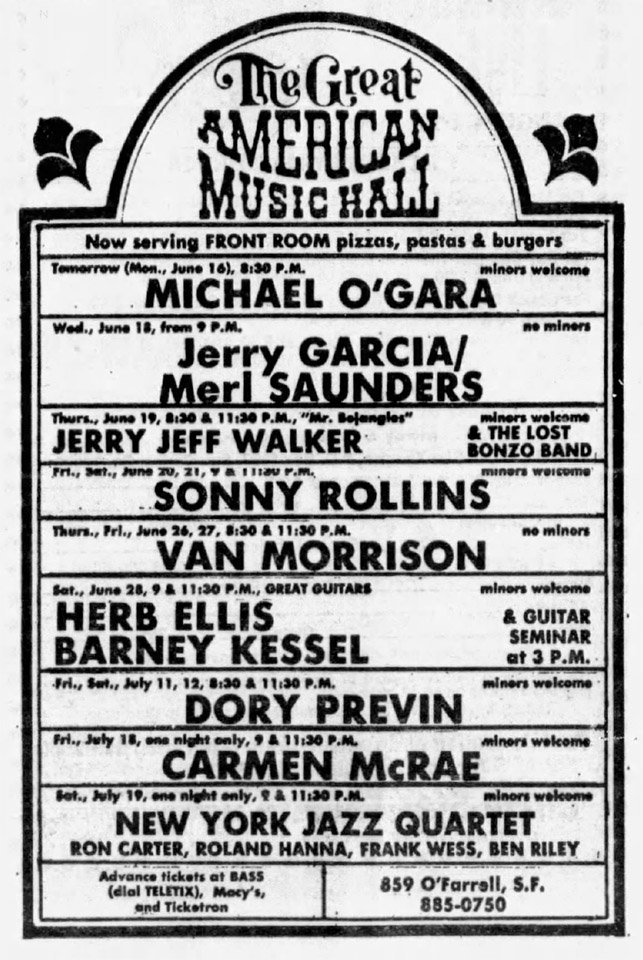
The Keystone in Berkeley is rightfully considered Garcia's homebase in the 70's until the mid-80's, but he also played the Great American Music Hall a lot in 1974.  2/5/74 marked the beginning of a long stretch.  The economic implications of this are more in the JGMF/Lost Live Dead wheelhouse, but it nevertheless strikes me as interesting.  Do we know who was promoting these shows?  I am sure they were happy to fill all those weeknights (see below) with a money maker like Garcia.  The venue was slightly larger -- 600 vs. 475ish at the Keystone  -- and the GAMH appears to have been a much classier joint: it also served food, and the decor was a considerable step up from the Keystone, not to mention that it also sported a pretty colorful history.  The club seemed to book the typically eclectic range of local Bay Area and national acts, but not much in the way of rock & roll.  A few major jazz artists recorded live albums there: Sonny Rollins, McCoy Tyner, Carla Bley, Betty Carter, and Carmen McRae, plus acoustic artists like Doc Watson and David Bromberg.  I am surprised that Old & In the Way never played there.


[edit: Jerrybase has since updated this list, which I will not bother to do myself: see here] 

7/19/73 (Thurs) - the first circulating recording of G/S with Martin Fierro; Fierro said that he first played with Garcia at the Matrix with Howard Wales, but afaik no other evidence exists of that. The first time G/S played the GAMH was a release party for the Fire Up! album, and featured Fierro, Sarah Fulcher, and Matt Kelley all guesting during the 2nd set [partial sbd tape]
2/5/74 (Tues) [sbd tape]
2/12/74 (Tues) [uncirculating Bettyboard, partial?]
3/2/74 (Sat)
3/10/74 (Sun) - David Grisman, Richard Greene & Vassar Clements, with Garcia as guest (no tape); see jgmf
5/2/74 (Thurs)
5/20/74 (Thurs) [uncirculating Bettyboard]

7/14/74 (Sun) - with Stephen Stills and Jack Cassady as guests - see jgmf

7/23/74 (Tues)
8/7/74 (Weds)
8/15/74 (Thurs) [aud tape]
8/24/74 (Sat) [sbd tape]
8/28/74 (Weds) [8 tunes released on the "9/1/74" Pure Jerry set; see jgmf]
10/6/74 (Sun) - with Jim Nelson, drums [partial sbd tape]
10/30/74 (Weds)
11/28/74 (Thurs) [sbd tape]
12/16/74 (Mon)
2/27,28/75 (Thurs, Fri) - the first time billed as the Legion of Mary? [2/28 partial sbd tape]
5/15/75 (Thurs) [aud tape]
6/18/75 (Fri) - billed as Garcia/Saunders, not Legion of Mary [Danny Siewell (of Wings) played drums]. fwiw, I am confident that the tape circulating with this date is actually an aud of 7/4/75.
7/4,5/75 (Fri, Sat) [7/4 sbd tape] (ahem)
7/30/75 (Weds) - maybe, but unlikely? as per jgmf
8/13/75 (Weds) - aka the GD's One From the Vault; see Lost Live Dead
8/20,21/75 (Weds, Thurs) - originally advertised as the Jerry Garcia Band, actually Keith & Donna Band with Jerry as guest [8/20 partial sbd & full aud tape]

unknown (blues?) band, courtesy GAMH via 7x7


Sunday, December 15, 2019

a week in Jan 1979 (put on the snow tires)

There's been a lack of serious Dead listening 'round here lately, but this little project oddly pulled me out of a slump.  I am drawn to periods that are generally overlooked or underrated, both out of a desire to find some buried treasure and also, it must be said, out of a weirdly perverse attraction to the mundane.  The Jan-Feb 1979 tours have not gone down in the books as the band's best, and justifiably so.  And yet here I am, always on the lookout for an unearthed gold nugget.  You already know that this was the Godchauxs' final stand, and that several of these shows were makeups for Dec 1978 shows that were canceled because of Garcia's illness.  A week after their final blowout at Winterland, I am sure that none of them were too jazzed to be touring the northeast in January.  I was born in New Haven in January 1979 and have been told repeatedly by my family how horrible the snow was.  An online buddy Pig Street attended some of these shows and reports similar conditions.  Party on!

Spoiler: none of these shows are top-to-bottom great, but many of them have something worth hearing and revisiting.  Isn't finding those gems what it's all about?


1/5/79 - The Spectrum

The band's history at the Spectrum is notable, and this was their first two-night stand there, rescheduled from December and split over two weeks, presumably working around the hockey season.  It's a pretty run-of-the-mill show, captured on a solid if not amazing aud tape (all respect to the uncredited taper).  Two unfortunate tape cuts excise Jerry's climactic Sugaree solo and most of the Music Never Stopped jam.  Weir's slide solo in Sugaree sounds truly and unbelievably terrible.  An unexpected highlight is the last stretch of All Over Now, when Garcia and Lesh decide it's time to lift the roof for a few moments.  The second set jam begins with a somewhat sluggish Estimated, which perks up during an unusually colorful segue into a very long Eyes of the World: 16 1/2 minutes of legitimate jamming.  Nothing earthshaking happens, since Garcia sounds happy to take it at a mellow pace, but it's still a pleasant ride.  A loud, raucous Space (all hands on deck and making noise) sets up a more energetic post-Drumz: it sounds like they're having fun on Truckin', and then they attempt the first Nobody's Fault But Mine in a while -- it's a full band effort, not just Garcia playing the melody -- but Garcia's mic gives out and they're forced to make it an instrumental.  Black Peter sounds quite good, though Garcia seems to be making room for Weir's slide again (whyyyyy), and Around and JBG feel unusually goosed.  "Thank y'all, we're gonna see you in a week or two."  Not bad, but overall it's a so-so show.  At least the local reviews were good.


high times at MSG, by Bob Minkin.

1/7/79 - Madison Square Garden 

Another historical first, the band's maiden MSG shows (again rescheduled from December).  Boy howdy, do they sound glad to be there: the run blasts off with a truly titanic Jack Straw, with a jam for the ages.  Mama mia!  The rest of the set is wholly unremarkable, which feels almost cruel given that opening salvo.   There's a pretty nice Cassidy and Jack-a-Roe; Garcia sings "kicked my eye and blacked my dog" in Tennessee Jed, and delivers on a solid Passenger closer.  True to their we-always-blow-the-big-ones form, the second set is marred by PA problems: the opening Miracle has some sound issues, Shakedown feels perfunctory, and repeat Estimated > Eyes finally finds a groove but is also on the shorter side.  Space is an unexpected highlight, with a kind of "world music" vibe as Garcia improvises more melodically with Hart's marimba.  But Not Fade Away feels bloated and overlong to me, although there's an interesting bit where everyone is trading fours, and Black Peter (another repeat) is going well until the PA craps out again, never to fully recover.  Blah.  Hear this Jack Straw over and over, and maybe the Space.  Full disclosure: Bob Wagner's aud tape is solid, but boomy and a little unfocused, which may be tilting my general opinion here.


1/8/79 - Madison Square Garden 

The first set is great!  Good selection, great energy: a very fine Half Step > Franklin's kicks off with a satisfying peak to the Half Step jam and a nice transition.  Everything has the extra edge, and even the more obvious flubs sound more like over-enthusiasm than carelessness.  Lazy > Supplication, another good combo, closes things out.  Promising start!  As much as I really want to love this second set, however, I am just not feeling it.  On paper it's great, and Charlie Miller has repeatedly said that this is one of his particular favorites.  So your mileage, obviously, may vary.  Scarlet > Fire features an unusually prominent Donna "solo" in the transition jam, more forward than her other occasional moments of glossolalia -- you go ahead, Donna! -- and Jerry bumbleebeing his way through the rest of it.  Hmm.  He steps it up for FOTM with one well-crafted solo after another, but the rest of the band sounds like they're plodding along.  Maybe it's just me?  This S>F certainly has its proponents (e.g. here), so perhaps you all will like it more than I do.  Nothing much moves me either in Terrapin or Playing, and they skip Space altogether tonight for some noodling right into the Other One, which doesn't feel like it fully comes together before the vocals.  Wharf Rat, at least, is a powerhouse.  It's interesting that all three of these shows so far have had an energy bump after the Drums, but haven't quite delivered the goods beforehand.


MSG, by Bob Minkin.
1/10/79 - Nassau Coliseum

And another historical moment: the Dead return to Nassau, which they had sworn off in 1973 after heavy police presence and arrests.  A few good pulls were made, but Keith Gatto's aud tapes of both nights are spectacular, which I admit may contribute to my higher opinion of these shows.  The first set mostly lopes along without much spark (the B-grade song selection is partially to blame), but ends well with quality versions of Passenger and Loser before a hot Music Never Stopped finale that burns through both jams to a big finish.  Shakedown is a much better performance than MSG's (prompting Phil to crack, "you know it well!" to all the Long Islanders), but then a workmanlike Miracle > Bertha > Good Lovin' seems like they are settling in for another unremarkable 2nd set jam.  But oh no: a full blown Dark Star.  How?  Why?  Huh?  Remember that they had brought this back ten days earlier for the closing of Winterland blowout (and would play a shorter one again 10 days later), but this one takes the full ride for over 18 minutes, complete with a nice climax in the second half.  imho this vies with the 1984 Greek Theater encore for the best of the "lost years" Dark Stars, and what a nice surprise it is.  Space, thankfully, is another full-blown skronk-fest (crazier than 1/5) with another big climax, dropping off into a decent but unremarkable Wharf Rat.  They have one more ace to play: St. Stephen, another reprise from Winterland (and the last one they would play until 1983), a pretty on-point and fired up version.  Thank you, boys!  Dark Star through the end of the show is well worth hearing.

1/11/79 - Nassau Coliseum
(a rare sbd also circulates, though the aud is the better bet)

I wasn't expecting much from this more pedestrian looking setlist, but surprise surprise, the first set felt pretty solid.  A big ol' Sugaree opener boasts a great final jam (and less egregiously bad Bob slide), and there's also a nice Cassidy and a solid-if-not-amazing Jack Straw > Deal finisher, both with some slippery spots but an all-around good feeling.  The second set opens with a very long, jammy Miracle, by far the longest (10+ minutes) of this period, with a nice, easy, quasi-Truckin' shuffle.  The band goofs around wishing happy birthday to everyone ("the Birthday Brothers & Sisters Band!") before setting sail into the best Estimated so far (though check out Jerry pulling the e-brake hard in the bridge solo) with a lovely, nearly composed transition into He's Gone.  They groove on a long Truckin' tease before Drums, then noodle around for bit before Truckin' proper.  They give this one another good reading and make their way roundabout to the Other One, with a great transition to the intro and a short but very punchy jam, and finally a very slow but steady Stella Blue with an extra long outro solo -- not a true stunner, but a worthwhile trip -- before wrapping up the night a fine Casey Jones encore that I hope was a little parting fuck you to the Nassau police.  Start to finish, this may be the most consistent second set of these six shows, though nothing jumps out enough to make it one for the books.  A worthwhile specimen, nevertheless.


1/12/79 - The Spectrum

Back at the Spectrum for night 2, with Eddie Claridge's and Jim Wise's sweet, up-close FOB as the only circulating recording.  The first set is mostly pretty ho-hum (the opening Jack Straw doesn't hold a candle to the MSG version), but things settle into place with a nice Peggy-O, and a great one-two punch of Passenger and Deal.  The energy spills over into a nice Samson, though Garcia's voice isn't in good enough shape for Roses.  Yikes.  Dancing in the Streets had become far less common than it had been in spring '78, and while it seemed like the band's interest in stretching this one out had been waning, this one pulls a rabbit out of its hat: after a brisk, tight jam, they bring it back around and then wander off into a looser groove; it's nice them exploring an unexpected direction at this stage in the game.  Garcia manages to tie it back into the Dancin' reprise, they wrap up the tune, and then Garcia sets off again as everyone else takes a break.  Hart eases off, and the next few minutes are just Garcia and Kreutzmann playfully sparring with each other -- nothing like John Coltrane/Elvin Jones intensity, but it's pretty cool to hear these two having a rare 'alone together' moment.  Hart returns for a low-key Drums, which ushers in a Not Fade Away that (after another grimacey slide solo) is elevated by Garcia powering through the rest of the band's laconic groove with a stronger attack.  A bonus GDTRFB and Sugar Magnolia (no ballad) keep the energy and good vibes up high.  It's worth hearing this Dancin>jam, and worth sticking around for the rest of it if you're not in a rush.

1/12/79? by unknown


Takeaways
None of these six shows is a powerhouse from start to finish.  With the exception of 1/8/79, all of these first sets are pretty skipable, barring a couple highlights.  The first two shows are generally pretty low-gear and low priority.  I keep hoping that 1/8/79's second set will turn my crank someday, but it hasn't happened yet.  Things get genuinely engaging for me with the second set of 1/10 Nassau, 1/11 maintains the energy for an all-around generally solid show, and 1/12 delivers with an overlooked strong second set jam.  But I'm not feeling inspired to keep going, so this symmetrical six-show run will suffice.   fwiw, the second set from 1/15/79 in Springfield is probably the best single set of this final winter 79 period (though, again, the first set was mostly a snoozer, iirc).  2/3/79 Indianapolis is another real diamond in the rough, and I presume most folks know the final Keith & Donna show on 2/17/79 has some very spirited (if messy) playing and a host of setlist surprises.

The "problem" with these shows has less to do with any obvious flaws and more of a kind of settled but indifferent professionalism (well, professionalism by the Dead's standards).  "We used to play for acid, now we play for Clive," perhaps.  Jerry's and Donna's voices sound pretty blown out more often than not, Keith never sounds too engaged in any of it (though the tone of the electric piano he was playing isn't doing him any favors), and everyone else just kind of plays on through.  As much as history has firmly attributed this to the Godchauxs, it sounds to me more like a cloud had settled on the band in late 78 that didn't fully clear until Brent Mydland was fully settled in a year later. 

1/9/79: Keith is not amused (Bob Minkin)

Friday, November 1, 2019

update re 2/19/69

Heads up: I was reading an article about the remnants of a record collection from the 60's commune at Rancho Olompali, which led me roundabout back to Light Into Ashes' post about the 2/19/69 Celestial Synapses show (and some very helpful recent comments), and I was nerdily inspired to updated my own post a bit.  Pictures! Local history!  Hippie entrepreneurs and lurid drug stories!

See here:
http://deadthinking.blogspot.com/2018/01/21969-jamjamjamjam.html


Monday, October 7, 2019

Jerry Hahn, Moses, and Merl

courtesy discogs
Jerry Hahn was a guitarist who was active in the 60's San Francisco jazz scene.  His first big gig was with saxophonist John Handy's group (perhaps not well-known to many casual jazz fans today, but Handy was big at the time, having been signed to Columbia by John Hammond), and then with rising star Gary Burton.  Hahn's own debut (Are-Be-In, 1967, for Arhoolie) touched on the same jazz-raga-rock vibe as stuff like Butterfield's East-West, Gabor Szabo's Jazz Raga, or Pat Martino's East.  In 1970, he released the cult-classic The Jerry Hahn Brotherhood, by his group of the same name, on Columbia, which to this day has still never been reissued.  The JHB seems to have worked a lot around the Bay Area, and opened for some major acts on the Fillmore circuit, and Hahn also got the call to play on Paul Simon's debut (post-Garfunkel) album.

Three years later, Hahn recorded a 'solo' album, Moses, for Fantasy Records.  The band was his JHB rhythm section -- Mel Graves on bass, George Marsh on drums -- and Merl Saunders as a last-minute addition, on organ and synthesizer.  Moses is a good record, though not one that I personally return to a lot as a whole album.  Stylistically it's a little all-over-the-place: the title cut (which I can listen to all day) is wonderful, a midtempo funky groove with a vibe that would have fit Garcia/Saunders perfectly; ditto the cover of Donovan's "Sunshine Superman."  Hahn's originals have an edgier, fusion/jazz-rock feel; two of them are 'suites' that jump around even more.  Then there are a few 50's-era standards, played well but comparatively straightforward.  It's kind of an odd mix when taken as an entire album, imho.  But all of it is very good.  imho, if they had cut less material and just stretched out more, it might be even better -- most of the tracks are under five minutes.  Like the JHB album before it, Moses has so far never been reissued in any digital form, anywhere.


So what does this have to do with this blog?  I am curious about the brief intersection of Jerry Hahn and Jerry Garcia and am wondering if there was more to it than is generally known.  I am also interested in this album as it relates to Merl Saunders' own involvement with the scene around Fantasy Records.  But there are no concrete conclusions to draw; so for now, consider some inchoate observations:
  • per George Marsh: “[Garcia] had his own group and I met him then and I was in the Jerry Hahn Brotherhood and we played [the Matrix] also ... So one of those times, it was set up that Mel Graves, the bassist, and myself and Merl Saunders played with Jerry one of the nights at the Matrix” (here).  He elaborated in an interview with Jake Feinberg that Saunders played on both of these nights: one night with Marsh, Graves, and Hahn, the next night with Marsh, Graves, and Garcia.  The Chicken On a Unicycle list of Matrix shows (which I realize is both outdated and probably incomplete), don't show Hahn and Garcia ever performing on the same night; there's a back-to-back booking in April 1970 (Garcia Monday night jam on 4/20, Hahn on 4/21-22), but I am pretty sure that Saunders wasn't in the mix at that point [can't be 4/20-21-22; Howard Wales is on the bill for 4/20].  Marsh does dimly recall to Feinberg that he jammed with Howard Wales at one point, but the details are lost.  The JHB also played the Matrix a lot -- 26 times in 1970, according to that list -- so it could easily have been some other time.  At one time, Corry Arnold thought that this Garcia-Saunders-Graves-Marsh performance was that December.  Re: this same general time period, Corry has also speculated whether Hahn might be the mystery guitarist who sat in with the Dead for a brief but unique jam at Winterland on 4/15/70.  Hmm.
  • We do know for sure, however, that the Jerry Hahn Brotherhood played at Pepperland in San Rafael on 12/21/70, along with the New Riders, the very short-lived Crosby-Garcia-Lesh-Kreutzmann ensemble, and, possibly the acoustic Dead (per Michael Parrish's eyewitness account -- with pictures! -- plus more via jgmf).  So that's at least two Garcia/Hahn connections, albeit fairly minor ones for two guitarists who were both pretty busy.
  • The Moses sessions were Jan 8-11, 1973 at Fantasy Studios in Berkeley.  Four sessions seems like a lot of time for an album like this, but what do I know?  Marsh recalls in the Feinberg piece that the group went in as a trio, but recruited Merl in passing to play on the record.  Corry Arnold also relates that "Hahn was set to record at Fantasy as a trio with Marsh and Graves. However, they saw Merl Saunders in the Fantasy cafeteria, and invited him to play on the album," but also that Saunders was recruited by the producer "so that [Hahn] wouldn't go completely off to Mars" -- for what it's worth, however, the back of the record says Hahn produced the album himself -- which may explain why a fairly small-group jazz record took four sessions to record.  
  • Is it possible that Garcia was hanging out at any of these Jerry Hahn sessions with Merl at Fantasy Studios?  Garcia was working on Baron Von Tollbooth with Kantner, Slick & co. on Jan 8-9  (thank you jgmf), but is it possible that Merl mentioned these unplanned studio dates to Jerry, and that Jerry swung by to check it out?  Marsh doesn't say anything about it in the Feinberg interview, so I'm inclined to think not -- but then again, he doesn't mention the Pepperland thing, either, so it's not out of the question.  Given that Jerry circa 1973 seems to have rarely spent an idle day doing something non-musical, it seems conceivable.  Or maybe he was pickin' with Grisman and Rowan on his front porch (pretty likely, actually, per Corry's pre-OAITW timeline), or rehearsing the new batch of Wake of the Flood-era tunes with the Dead, or hanging with Healy and the sound crew working out kinks in the Dead's new PA, or something else entirely.  
  • Or could it also be possible that maybe Merl invited Jerry Hahn to come to the Keystone where Garcia/Saunders were playing on Jan 12th-13th?  or perhaps to some other gig?  There are a lot of Jan 73 Garcia/Saunders show that are unrepresented by any tape, and personnel was still fairly fluid in that group at this point.  Second guitarist George Tickner was added for a few shows that spring, as was singer Sarah Fulcher.
  • update, Dec 2019: speaking of Sarah Fulcher, Jesse Jarnow interviewed her for the release of the 1/23/73 Boarding House show.  She reveals, "me and Merl and John and Bill Vitt did some recording [at Alembic Studios] with another guy playing guitar, and he sounded just like Garcia.  Well, as much as anyone can."  Jarnow adds this note: "My esteemed colleague Corry Arnold suggests this guitarist might be Jerry Hahn, house guitarist for Fantasy Records."  As far as I  know, Hahn isn't credited on any other Fantasy albums besides his own, but I would be very interested in finding out more.  Wouldn't it be fascinating is this is really what happened?  [JGMF, to the rescue yet again, notes that "On 3/13/73, Betty [Cantor-Jackson] did a session noted as Sarah, Merl, Bill Vitt, 16 track playback," as per files in the GD Archive]
  • It is worth repeating that Merl Saunders was a total pro and a master musician.  Anyone who knows something about Garcia's life outside of the Dead has some understanding of the profound influence that Merl had on Garcia's development as a musician, but I still don't know that many Garcia/Saunders fans listen all that closely to Merl as a soloist -- I don't see much in the way of comment about him, at any rate.  Merl apparently just walked in and played here.  I'm sure it was no sweat for him to reel off standards like "All Blues" and "Joy Spring," or the funk of "Moses," but some of Hahn's stuff is pretty spiky and Merl adds just what is needed.  It is also worth noting that Merl is playing some synthesizer on Moses.  The Jan 73 G/S shows are, I believe, the only times that we hear Merl playing a synth in performance (allowing, again, there are big gaps in our knowledge of many of these shows).  On stage, the effect was a bit underwhelming, but he sounds far more comfortable with the instrument in the studio. 
So I dunno: some speculation, some more insight into the musical prowess of Merl Saunders, some interesting musical digressions.  Never a bad thing.  I would certainly like to learn more about Merl's relationship with Fantasy Records/Studios and the influence, direct or not, that it had on the Garcia/Saunders band -- starting, I presume, with Tom Fogerty, and extending into the general influence that the label's output had on Reconstruction (more later, someday).  But, for now, it's just another piece of the puzzle.