There's a quote somewhere (I told the intern to go look it up; dunno where he got to, though) where Jerry says that a song ideally has a moment of pure silence in it. I'm pretty sure he was talking about Stella Blue, but this is a good one to file away next to other nuggets about the musical value of not playing anything. Silence in Dark Star, or "Space" jams in general, isn't exactly a rare thing, so I don't want to make too much of it: but there are two very small ones in this Dark Star that are perfect, like pinholes into infinity, and I would like to acknowledge them. It is the 50th anniversary of this behemoth piece of music, and almost 15 years ago I banged out an appreciation about it that needs no revision to sum up my feelings -- but in the years that followed, I have come to love one additional specific thing about it.
In that original write-up, I mentioned a CD copy of this show that I was fortunate to get sometime between 1999-2001 that tracked the "tuning" and "intro" separate from the main Dark Star. On that copy, Dark Star itself was tracked when Billy slides into his swinging cymbal beat as Jerry trickles in (@3:10 on the current fileset), but the "intro" began at 1:28 -- the moment where, to my ears, the tuning ends and the gentle but wholly intentional playing commences. This magical little black dot of silence is what always bring to mind Tom Constanten's words about Dark Star being a thing that you enter, not a thing that you start playing.
The instrumental texture of Keith's Fender Rhodes and Phil's bass chord at 2 min is about a warm a sound as I've ever heard from the Dead (or, really, most anything this side of Jaco Pastorius' "Portrait of Tracy" or John Martyn's "Solid Air," but I digress)
If anything, I downplayed just how much Keith is playing in this. I wouldn't call it overplaying (although it seems like 300% of what he usually plays), since I do feel that he is completely zoned in and doing exactly what ought to be happening. But Bob seems a bit more reserved in this, and I suspect part of the reason is that Keith was just taking up more space than usual. But go ahead Keith! It sounds perfect. After the scorched earth Phil/Jerry showdown that decimates the second half of this, who's feeling all perky and ready to get back on the road? Keith is.
Then at 29:13, comes the second great silence: the only sound is Jerry just scraping a string very quietly, and there's another tiny pause -- debatably there are one or two more in the quiet passage that follows over the next minute. Everyone is listening so hard and the tension is palpable. And then things get very, very loud indeed.
Wednesday, December 6, 2023
12/6/73 at 50: ideal silences
Thursday, November 16, 2023
Ornette meets Healy
jazz tangent: one thing that has pulled me away from more consistent GD/JG listening (besides the ebb and flow of life) is my new hobby (calling it a "practice" makes me wince) of listening slowly to entire discographies of jazz greats who I want a more comprehensive overview of (so far, since you asked: Bobby Hutcherson, Yusef Lateef, and Sun Ra). I am working on Ornette Coleman right now.
In August 1968, Ornette was in the Bay Area with his band that included, controversially, his 12-year-old son Denardo on drums. His brief spell with Impulse! Records produced two live albums, the first of which, Ornette at 12, was recorded at the Greek Theater in Berkeley on Aug 11, 1968. Working that show was the GD's soundman Dan Healy -- the LP notes credit him as engineer (misspelled Healey), so I don't know if he was also mixing the live sound or just recording it (I suspect both, since I think Ornette produced this himself and just licensed the tapes to Impulse!). There is more from this concert that remains unheard: it was billed as Ornette Coleman & Orchestra, since part of the SF Symphony joined for his composition "Sun Suite" (unrecorded, afaik, though that's the score on the Fillmore West poster below!), as did his former bandmate, trumpeter Bobby Bradford. But the album only features performances by the quartet, so maybe the rest didn't go as well? I would sure love to hear it anyway.
The week before the Greek concert, Ornette's quartet played at the Fillmore West on Aug 5, apparently one of Bill Graham's only single-night/single-act bookings (the poster advertises the band as a quintet with Bradford, but he has confirmed that he was not there). A month earlier, Graham had taken over the venue formerly known as the Carousel Ballroom and renamed it. Given that his capitalist ways marked the end of the hippie dream of a communal venue, the story goes that local musicians were briefly boycotting his new venture, and Rhoney Stanley recalled in her book that Jerry Garcia broke with principle only to go see Ornette play (thank you again, Light Into Ashes, for sharing that quote), although I can't help but notice that the Dead were booked at the Fillmore West on Aug 20-22 and again on Aug 30-Sept 1.
Healy had been working with the Dead from mid-1966 until mid-1968. The exact reasons for his departure are unclear, but Corry Arnold speculates that, with Owsley returning to the GD organization, Healy may have sought fresh opportunities elsewhere. He worked with Quicksilver Messenger Service (as soundman, producer, and sometimes bassist!), played with his own band (the nearly forgotten Hoffman's Bycycle; Corry ibid.), and worked as a freelance engineer with some connection to Mercury Records (Corry again, also Light Into Ashes). And he didn't really fully cut ties with the Dead: he recorded them in Los Angeles on Aug 23-24 (interestingly, Quicksilver was booked those nights at the Fillmore West), using Warner Bros' fancy 8-track equipment, which was eventually released as Two From the Vault (some info), and evidently was in and out of the studio with them until his full-time return in 1972. But could Healy have also worked the Ornette show at the Fillmore West? It's certainly possible, but we'll never know unless someone asks him.
So what? So I think that's all pretty cool. Healy gave plenty of interviews, and I have only looked at a few of them. But I am guessing no one has asked him about this Ornette concert at the Greek. As far as I know, this is his one jazz recording credit, and, of course, it sounds good. And Healy did, of course, mix for Ornette at least twice again: when he opened for the Dead and then sat in on 2/23/93, and again on 12/9/93.
Tuesday, November 7, 2023
11/7/93 until he organizes his best potential
![]() |
| wrong show, wrong band, great pic: 9/29/93 by Robbi Cohn |
I have alluded to loving this overlooked show before, so for its 30th anniversary (at the eleventh hour, of course), I figured I would kick myself to write about Jerry Garcia again and say a few things about it.
In his great book Every Song Ever (2016), Ben Ratliff observed that being a deadhead -- specifically, collecting and listening to all these shows -- means "to practice long stretches of suspended judgment until the group organizes its best potential."
It is listening in the long view, with a basic understanding that the band’s music only significantly changes when the body gives out; otherwise, that music represents one long discourse, all of it intrinsically valuable.
If you enjoy Garcia's music from his final years, then surely this must be true for you, whether you think of it this way or not. It is certainly true for me, but not for reasons of "I was there!" nostalgia or relativism ("I guess Jerry sounds pretty good... for a guy who could barely keep his head up and was near the end"). There are things I hear Jerry play in 1993 that hold up as being as powerful as anything he ever did, although very different from his work as a younger man. In 1993, Garcia's best potential, as Ratliff would put it, was not the same potential as 1973 or 1983. Assessing the work of artists who rely on technical ability (like musicians) as they age can be challenging, given that our terms of engagement with their work often focuses on innovation or "development" rather than consolidation and refinement. Jazz critic Stanley Crouch argues this about Louis Armstrong:
As maturity increases, the speed of perception and experience becomes denser, fewer details are needed to recognize essential meanings. While the younger person is still contemplating, the old master has moved on to the next point, digesting through the shorthand made possible by the passage of many moons. In art, that law allows the individual gesture to take on greater resonance. The best of Louis Armstrong's work after fifty proves that his expressive ideas didn't reach their peak until he was nearly sixty. (Crouch, Considering Genius)
I realize I am wandering out on the thin ice of romanticizing "old Jerry," and let's be real: his physical health was in real deterioration by 1993, and his mental/emotional well-being was not being helped by, to use another shorthand, the Burden of Being Jerry. And yet, all those shortcomings aside, the old master Jerry does make some gestures here that do take on a greater resonance for me, and hopefully for you too.
So: Nov 7, 1993 at the newly rechristened USAir Arena (formerly the Capitol Centre) of Landover, MD. The JGB's final east coast tour, very close to the abrupt end of the great David Kemper era, but traveling in fine style nevertheless. From what I understand, this particular venue was known then for its particularly tough security, and the two circulating audience tapes both suffer from that. I personally prefer the earlier unknown Schoeps source which to my ears is slightly more palatable than the tape made by the usually reliable Clay Brennecke (no fault of his own; he gets busted early on, sounds like he bribes his way out of a pickle, and gets the rest of the show, albeit with a bit more discretion, I'm sure)
- Not much to say about the start of the first set, but ol' Jerry was saved more than once by the adage, "when the going gets tough, the tough slow down." And the first important thing that happens is the late-set SeƱor: my single favorite performance of this amazing song, thanks to its guitar solo. Find me a better one (official released included). Four choruses of perfection -- okay, then two more choruses of unnecessary but by no means bad extra stuff. Vocals have their rust spots and occasional brainfarts, but that's rarely on my rubric when he is playing so well. I suspend my judgment until the group organizes its best potential.
- Everybody Needs Somebody to Love. I have more to say in general about Garcia's stripped-down arrangement of this already simple song (all good things), but by fall 93 it had turned into a behemoth, a slow-rolling tribal stomp, and a thing of glory. This is not quite the best that it got -- at the moment, I would nominate 11/3/93 for that (another post) -- but this is pretty damn near the top. 14 1/2 minutes of a giant ball of energy just rolling around and around and around the stadium.
- The second set opens with another all-timer: show me a better The Way You Do the Things You Do. Another tune that warrants a more in-depth look sometime, it was performed in a straightforward Motown-goes-barband style for eight years, left the repertoire for six, then reappeared in 1990 with a reggae-ish sway, courtesy of Jahn Kahn's most memorable bassline and a gently spacey groove. The end jam would swell and occasionally became ground for some inspiration to blossom, and this version is the epitome of that (although see also 11/18/93 for a sprawling 20+ version that is also a treasure). Jerry grooves along, slides into some jazzy comping for a minute and a half, but never fully cedes to Melvin Seals. Instead, he builds tension by playing not much but teasingly just enough, finally eases back into more proper lead guitar, but the focus seems more rhythmic than melodic, and then finally lets all that tension boil over (@12:35ish) with some climactic fanning for about 40 seconds. This will be a very nice surprise if you primarily associate this tune with a few jammy minutes of light, bubbly grooviness.
- Money Honey. Not quite a rarity, but not a setlist staple either, and my hunch is that it was generally a good sign when Jerry felt like belting this one out. Again, not perfect lyrically, but he delivers a few choruses of divebomb blues with his claws out.
- Knockin' On Heaven's Door. A semi-rarity; the only one of the tour, and only played three more times onstage in his life (once with the JGB, twice with the GD). You know how you feel about this song, and this version is lovely.
- Don't Let Go. All-timer? No. But damn good, I say. Appreciate how Jerry playfully sings way down looow in the final round of "hold me tight and don't let go"s, while Melvin mimics his vocal. Then he tears the heck out of the jam, brings it up to a nice climax, then collapses into lonesome space for a few minutes, the Hammond B3 framing Jerry's moaning in the moonlight, before he brings it back home. Not too many Don't Let Go's were ending in free space anymore (list forthcoming, hopefully?), so that's a nice touch. Overall: a mighty fine Don't Let Go.
- Mississippi Moon. A real rarity for the 90's, and the only one of the tour again. Again, there are some rust spots on the vocals and the turnarounds, but Jerry digs in for the solo, and then digs in again for a unusual(?) second solo after Melvin's featured spot (which was usually the piece's climax).
- After all that, I wish that Tangled Up in Blue came crashing into the end of this set like a missile, but it does not. It's a little slow and maybe too carefully paced at first, but he gets the truck out on the highway and invites you to ride it out with him. He might be coasting a bit during the solos, but as the jam begins, he seems to pause for a breath, braces himself, and channels some that Leo energy into a regal final jam. There's nice energy bump just before the 11 min mark that gets us across the finish line, but it all sounds pretty good to me.
Best potential organized? I would say so, yes. One long discourse, all of it intrinsically valuable. So I will end, as I ought to, with a salute to the tapers. Midway through Tangled, there's a moment when the high frequencies drop out, when (I assume) the mics are lowered and hidden. Then @6:45, the quality increases and, with a "whoo!" of relief, one taper hollers to the other, "the things we have to go through!" Thank goodness you did! Thank you tapers!
![]() |
| scan courtesy Fate Music/JGMF |
Saturday, October 29, 2022
10/28/72 hello Cleveland
![]() |
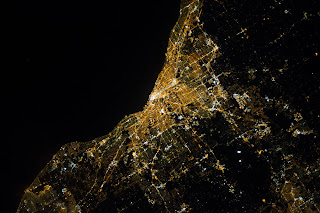
| satellite view of the Dead lighting up downtown Cleveland |
It is peak fall in my neck of the woods, and fall '72 feels very right right now. So here are some scattered observations about this show, not one for the "best of 72" list but a very enjoyable one, marred by a poor quality recording, and one that caught my eye for a couple of setlist oddities. Not to mention another big ol' Dark Star.
So, the Dead in Cleveland. Someone help me here: there's a Cleveland Convention Center with two venues, the smaller Music Hall and the larger Public Hall. The Dead played the Public Hall in 1972, 73, 79, and 80, but played the Music Hall in 1970, 78, and 81 -- is that right? There are pics of 12/6/73 in a larger art deco auditorium with a huge stage, which is said to be the Public Hall.
The Rowan Brothers opened this show, according to this review.
Like a lot of later fall 72 tapes, the mix stinks. I've seen many of these fall 72 sbds referred to as "monitor mixes" and I have repeated that myself, but I don't think that's accurate: from what I understand now, the band didn't have a separate monitor feed in 1972, let alone individual monitor mixes for different bandmembers. So my guess is that this tape (made by Bear) is a straight sbd feed. Vocals and drums are the loudest, Lesh's bass is the lowest, and the guitars and piano move around. It's what we've got.
Weir picks the opener for the show, but Garcia's first two choices this evening are Friend of the Devil and China>Rider. I have opined elsewhere that 9/21/72 has perhaps Garcia's most inspired opening gambit (Bird Song and China>Rider), but this sure ain't a bad way to get the ball rolling. As far as I can tell, this was the earliest placement in a show that FOTD ever had (with the Dead at any rate; dunno about JGB).
Another first set highlight is a spirited Box of Rain. I like how Weir screams loudly as Lesh counts it off. Weir screams a lot during this show.
Weir's mic craps out during Bobby McGee, prompting a pause for a replacement. Garcia noodles Teddy Bear's Picnic. Evidently someone from the crowd is throwing marshmellows onstage, which nobody in the band seems particular fazed about.
They play Candyman for the first time in just over a year.
Playing in the Band is, no surprise, another late '72 monster, nothing too unusual for the period, but whoa. Hard to fully assess what's happening here since the bass is so low, but Garcia and Kreutzmann are locked in like Coltrane and Elvin Jones, and the peak they hit @15:45 is wonderful (hear Weir holler in delight, yet again). There's a long, luscious swim back to the reprise that's marred by a small cut, but this one is still a keeper.
Opening the second set with He's Gone seems like the move of a supremely confident band. It wasn't actually that unusual a move in fall 72, but it happened rarely after that.
Greatest Story Ever Told is a freakin' rager! I mean they all are, but this one is extra hot. Jerrrry.
Attics of My Life! This was the second of only two played that year, and the last one in front of an audience until 1989! Oh woe. It sounds so good.
This Big River is not a particularly noteworthy one, but it does inaugurate a brief and unexpected tradition of Big River preceding a really heavy duty Dark Star (see also 2/15/73, 10/19/73, 10/30/73, 11/11/73, 12/6/73, 9/10/74 - weird, right?)
Roadmap to this monster Dark Star: This initial jam feels like I'm lost in a dark forest, groping towards bright lights in the distance. Lesh's bass is audible, but still lower than everything else. After 5 minutes, they smoothly pick up the tempo, Garcia sizzling away as Godchaux skips stones behind him; they're mostly cruising along in good ol' A mixolydian, and Garcia builds to a beautiful peak at 9:30ish, then settles thing down as he glides into the first verse a couple minutes later. Things proceed as usual as they ease back and Lesh takes center stage... he doodles around, Garcia and Kreutzmann join in, but just when things seem like they're about to tip over into darkness, Lesh begins strumming the chords of the theme that's now known for posterity as the "Philo Stomp" jam. Not a fan of that name, but oh well. It's an incongruously perky little thing, but everyone joins in and Garcia pulls back into the Dark star mode, and this just sounds triumphant. Check out him trilling @19:30! Oh man. By 22 min, Garcia has twisted off in a weirder direction and they start building to a Tiger, albeit via the scenic route. It boils over at 24:45, rages hard for a minute, then abruptly stops. They splash around for the final two minutes; I hear no piano here at all; and then Bob boots 'em into Sugar Magnolia. I wouldn't call this a Dark Star for the ages, nor even one in the top tier of 1972, but we're still talking about a full 3-course meal here; just stunning that something like this is second-level for the year.
This Dark Star, for me, will forever be associated with Dick Latvala's epic introduction from the Grateful Dead Hour, which was once upon a time the only source for this jam. Treat yourself to a listen. Dick sounds like he just snorked down a bongwater martini and would have been in no shape whatsoever to deliver a lengthy seaside chat. "My armpit left the universe." God bless ya, Dick.
Nice touch in Sugar Magnolia: during the pause before Sunshine Daydream, you can hear Bob jokingly tell Donna as she walks out, "take your time, take your time."
Casey Jones shuts things down with a classic drawn-out, hellraising ending. It sounds like Weir is telling someone down front to be careful and take it easy. He also keeps screaming his head off. Shoot the moon, Bobby, shoot the moon.
Sunday, August 28, 2022
not to wax nostalgic, but...
...ah what the hell, it's my blog. I was digging around in the one box of cassette tapes that has survived the decades (snicker if you want, but when you've been carting around a thousands LP's and CD's for half of your life, a box of tapes is easy to throw on the pile and forget about), and this is all that is left of my Dead tape collection:
There were more. But for reasons both known and unknown, these are what have survived a quarter century, give or take. At the time (the mid/late 1990's), I was more interested in getting as many Phish tapes as I could, so I never had a particularly enviable Dead collection. There were, of course, a lot of crummy aud tapes and super hissy incomplete sbds that were given away or taped over, but I did try to save the cream of the crop... and I know that Veneta, Cornell, Freedom Hall, NYE 78 were all complete at one point, but c'est la vie. 10/14/94 was my last Dead show (and a really great Scarlet>Fire, thank you very much). I have no clue how Garcia/Saunders 6/4/74 found its way to me, since I can't imagine it was a common tape in the pre-shn age. Note the misdated 10/8/68 Hartbeats tape! 11/8/69 has the irritating clicking noise that Jim Wise painstakingly repaired, manually, click by click, on a home digital workstation (the story), which was the first time I had heard of such a thing being done -- oh brave new world!
Also, let's have a moment of silence for the lost art of tape filler. The tape formerly known as 5/5/82 had the huge Mystery Train jam from 12/31/75 on the b-side, which made for an incongruous yet inexplicably satisfying juxtaposition. Ditto 10/16/89 which had just exactly the perfect amount of space to fit the Garcia solo track from Zabriskie Point as filler. Good filler was always the perfect comedown.
I wrote a while ago about the GD Hour broadcast of 1/22/78 that basically changed my life, and I am most pleased to find that that one has held on. But of course all of these were very, very special in their own way.
That's it. B&P welcome, or your list gets mine.
Wednesday, August 24, 2022
the Wildebeest connection
Joe and Corry tossed this around for a second back in 2016, so this is no great discovery, but the discographical nerd in me needs to mark this very marginal release with a post. I had stumbled upon this record a a few months ago while looking around Discogs for recordings that John Kahn played on. What really caught my attention was the presence of Jimmy Warren, who played electric piano alongside organist Melvin Seals in the JGB for 15 months in 1981-1982. $2.11 later (plus shipping), and I present: Reckless Dreams by Wildebeest.
I am curious about John Kahn spent his downtime when the Dead were on the road, since it doesn't seem like he played regularly with anyone else (did he?); so it makes sense that he would get involved with producing a local Bay Area band. The eyebrow-raiser is that the Dead organization was involved. Kahn brought Palo Alto's own Wildebeest into Club Front from April 1-5, 1981 to record a 5-song EP using the studio's 24-track Studer @30ips and Neve 24-track console. I know this because it says so prominently on the back cover, even before the names of the bandmembers are given. Kahn was credited with co-writing one song, and also played synthesizer on every track (Kahn owned an Oberheim synthesizer, not a common household item, and had encouraged keyboardist Ozzie Ahlers to play the same model in the 1980 edition of the JGB). Jimmy Warren was involved enough in the project to get a co-producer credit, and he adds a few synth parts of his own. Betty Cantor-Jackson and John Cutler were working the boards -- and, notably, Betty is also credited along with Kahn on the record label itself. That's a pretty unusual thing for an engineer, so I infer from this that her name had significant cachet with Deadheads even back then (remember, this was still years before anyone had heard of a Bettyboard). Even Sue Stevens of GDP is credited on the sleeve with "logistics and planning." So I am assuming that Kahn was calling in a favor here. He had certainly logged plenty of hours at Club Front with Garcia, but given that this project had no direct connection to the JGB or the Dead, one might assume that this happened only because Garcia must have given it the okay. And I suspect that Warren's role in this Wildebeest project was a mitzvah from Kahn -- but, as always, this is conjecture, and I would love to know more.
![]() |
| engineered by Betty Cantor-Jackson, in case you were wondering. |
![]() |
| pardon the unintentional selfie |
This may be unrelated, but I can't help noticing that Kahn also performed onstage with the Dead twice in this same time period, the only time such a thing happened: two acoustic sets at benefit shows (4/25/81 and 5/22/81), although neither was actually billed as the Grateful Dead. The story goes that Lesh claims nobody told him about it (also notably, a month later Lesh subbed for an out-of-town Kahn at a few JGB gigs). None of this may have anything to do with Kahn bringing a local bar band into Club Front for a week, but I wonder. [edit, July 2025: Lostlivedead made a recent examination of the Dead's acoustic benefit performances, including the two aforementioned shows, if you want some well-informed speculation]
This also prompts some speculation (on my part, anyway) about Club Front's function as a recording studio outside of the Dead's immediate orbit. I don't have any sense that it was used that way. But it certainly could have been -- and it certainly could have brought in some additional income, but the Dead's/Garcia's cashflow problems is not my area of expertise. Placeholder for that one for now.
Oh, right: and how's the music? It's okay for what it is. The cover could suggest either metal or loopy psychedelia, but it's more middle-of-the-road than either: some tunes have a Heart/Pat Benetar kind of vibe, others have a more rootsy blues-rock boogie with slide guitar. The beat goes on. But to be fair, I am sure they sounded much better in a bar like the Keystone than at home on the record player (this less-than-rave review in the Sanford Daily appears to agree).
Ah well. One more piece of the puzzle. For two bucks, it was a worthy purchase.
![]() |
August 1981: JGB on the 20th-21st, Sam & Dave on the 22nd, Wildebeast (sic) on the 23rd. |
postscript: a few words about Jimmy Warren
![]() |
| pic from Jake Feinberg's page, presumably a screenshot from the JGB 6/24/82 video |
Until Jake Feinberg aired an interview with Jimmy Warren in 2018, almost nothing was known about him in the deadhead world besides a strongly-worded implication that he was a drug buddy of Kahn's and Garcia's. In his fine interview, Feinberg understandably goes easy on the question of drugs. Warren explains, in short, that he moved to Mill Valley in the late 70's with his then-girlfriend Liz Stires, met and became friends with Kahn. The two would hang out at Kahn's home 8-track studio and record demos (Warren recalls playing on the demo of the Kahn/Hunter tune "Leave the Little Girl Alone" that was later recorded for Run for the Roses; Liz Stires also apparently recorded several demos with Kahn and Warren). Eventually, he was invited to audition for the JGB -- and Stires, as you probably know, also became one of the backup singers. Others have implied that he was there more for the procurement of the substances that were of great interest to Kahn, Garcia, and Rock Scully. No one seems to have spoken explicitly about it on the record one way or the other, and I am sure that the situation involves several stories that are both contradictory and true. But regardless, Kahn and Warren seem to have been close for a time. Warren also tells Feinberg a nice story: after he left the JGB and moved to Annapolis, MD, he was playing with a local band; after a JGB show, John Kahn came by one night to sit in (this must have been in the wee hours of 11/6/82).
![]() |
| Jimmy Warren, 9/7/81, pic by Don Aters from GarciaLive Vol 20 booklet |
Tuesday, August 16, 2022
Europe 72: the jams, pt 6
![]() |
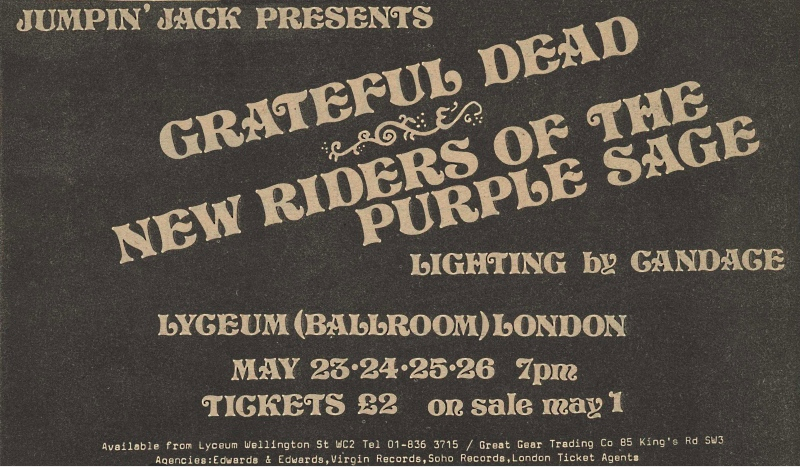
| lighting by Candace! nice touch. |
PART 6: LONDON (THE END)
5/23 London, Dark Star #10
Okay, so they make up for the double Other Ones (5/13-16) with double Dark Stars (5/18-23). All is in balance as we head into the final stretch.
This Dark Star starts off unusually tentatively, with Jerry playing the initial riff alone. But there's a nice floaty start to this opening jam and all is well. @1:45 Jerry and Bob twine around each other like ivy and spin out wonderfully for about 20 seconds. By 3 min, they're starting to leave the ground, generally calm and peaceful feelings abound. Jerry brings 'em back down to earth @5:30, but rather than drop off the cliff into open space as per usual, they instead do a slow black hole taffy-pull... there's a moment of near silence at 7:10, then Jerry starts sending out long feedbacked notes into the darkness and Phil scuttles away down below. Sparse. Just Jerry and Phil for a moment in here. This is the most far out they've gone before the verse so far (4/29 also got dark and spacey early on, but not for as long as this, iirc?). From 10:30 it's basically just Billy, joined by Phil and some minimal Bobby... though setlists historically don't seem to notate this as "Drums," that's what it feels like [edit: whoops, Jerrybase does] @13:13 Jerry quietly reenters, and by 14 they're back in flight, in a darker minor mode, but by 14:50 we get another bi-modal tug of war between Jerry/Bob and Phil. @15:25-40ish some Feelin' Groovy hints go unheeded, @15:50 Pigpen makes an appearance on organ, and it fits in well! and @17 min they pull up and move it into Dark Star for real. Wow, that was nice.
@17:43 Jerry sings first verse. @19 they stand at the edge of the cliff and peer over. Bob, Phil, and Jerry all quietly but melodically contemplate the void. by 21 min this has become unexpectedly pretty -- not atonal or weird at all. Some lovely unison lines @21:35 and I even something a bit like "Jesu Joy of Man's Desiring" from Jerry in there (no, not an explicit quote). But inevitably @22 min he turns left into something darker, and by 23 min Jer and Phil are getting spookier, then into the Tiger as everyone else piles on. It peaks by 24, then by mid-25 they drop down and splash around in the wake... but then they build back up again! Rather than another peak, @26:40 Jer turns off the wahwah and slowly they all change directions -- okay, this is a super cool and unexpected move -- pretty intense, and it finally resolves @28:30 into a cool jazzy groove (swingin' drums, walking bassline). A tasty digression indeed. @29:20 they're moving down back into the 2nd verse, but Jerry changes direction and plays the Morning Dew riff to get everyone's attention, then again for real as they make the segue. Wow! That was so good! And Morning Dew is a great one, just exactly perfectly good from top to bottom. 42 minutes well spent with the Grateful Dead, folks.
Well, this one I didn't remember being as interesting or involving as it was. But this was a powerful sleeper Dark Star for sure.
The penultimate Good Lovin' (#12) has no Pigpen rap at all. Yeesh. Jerry is way more in command here than the last one, and I suspect that it was clear from the start that Pigpen wasn't coming out for the jam tonight (whereas on 5/18 it feels like everyone isn't sure whether Pig's going to make it or not). Solid but pretty uneventful jam. Pig sounds a little off on the final vocals as well. 11:30 total.
5/24 London, Other One #11
I must confess that I haven't been playing very close attention to the Truckin's from this tour until the jams begin in earnest. But I noticed that the first jam here (before the reprise) has lots of Other One teasing in there. Hmm. Then there are <2 min of jamming after the last vocals with nothing much to report; there's one final Other One hint before easing off into Drums.
The Other One's opening jam felt a little more muted or relaxed than usual, and by 1:30 they're floating in open space... and they stay there for a while. There are some suggestions of other directions and/or moments of turbulence (Phil attempts his jazz riff at one point), and also of some real beauty: @4:50ish there's a beautiful cloud formation by Jerry, Keith, and Bob. But for the most part, this is a longer than usual passage of drifty airy space. The clouds roll in and @6:30 Billy is pushing things along and everyone gets on the same track -- a lot is happening in here, multi-modal shenanigans and generally a very cool jam from 6:30-9:00, then Jerry reasserts the Other One, then slows the tempo down after a minute. First verse @11:23, and then they fall back off the cliff into open space again. Jerry chisels away, Phil plonks along, it al gets progressively stranger but stays relatively calm for this sort of thing. @17:20ish Billy kicks in a quiet but driving groove, just as Jerry starts getting weirder... but after a minute of this, Phil sides (surprisingly?) with Billy and they pull Jerry into the orbit of a more linear, jazzy jam -- also I appreciate that Bob leaves his tremelo on. Keith reenters the scene, but it doesn't much catch fire, even when Jerry turns on his wahwah. They're groovin' along in 2nd gear. I again hear Keith using a volume pedal (?) on his piano around 21 min. By 21:40 or so, Jerry is quietly spinning towards the outer regions. But no deep delving yet! Again, they are taking their sweet time in the outer reaches. Finally @23 they all tumble into a Tiger and hit peak shreddage not long after, but then keep it going along the same lines, just with a lesser intensity (as opposed to collapsing and kicking around in the ashes) @25:08 Jerry very abruptly yanks it all back into the Other One, and Phil takes a minute to reorient himself. @25:55 it's back into the O1 for real, @28:47 2nd verse (nice organ fills from Pig!), and they end it and move into Sing Me Back Home. Which is beautiful! A really nice version.
So this is ultimately another second-tier Other One, mostly because they spend a lot of time free-floating without ever really digging in to any sustained inspiration. The 2 1/2 min jam before the first verse was the most exciting thing to me here.
The final Turn On Your Lovelight (#3 of the tour) follows Sugar Magnolia, and while Pigpen isn't quite spitting fire, this one is the best of this tour and certainly an improvement over the last two Good Lovin's. There's a nice dovetail into the finale, and then a surprise move into Two Souls in Communion, which Pigpen gives his all and really delivers. Good combination! And this was the last time that Pigpen ended a Dead show in the spotlight -- god speed, Mr. Pen.
5/25/72 London, Dark Star #11
I will confess upfront that this jam has a special place in my heart. I have listened to it many times over the years, ever since it soundtracked a particularly golden afternoon many years ago. The jam sequence is completely unique, which also adds that extra sparkle. This Uncle John's Band is an all-timer for me. @7:20 they drift away from the 7/8 riff into a looser kinda pre-Dark Star mode, until Jerry finds some definition after a few minutes and moves 'em into Wharf Rat. Pretty masterful transition there! They jam a bit after the last vocal and the trickle down into Dark Star is absolutely perfect. So at this point, they've been in flight for 19 minutes, so I am not in the same headspace as I have been for the rest of these Dark Stars... this one feels more like a "kaleidoscopic" jam at first, with all of them spinning in different directions but linked to the same grounding point, rather than a linear trip of everyone moving in the same direction. I dig it. @2:45ish I hear them coming together more, and I hear Bob & Keith really driving things while Billy lays back with more of a gentle pulse. Builds in intensity, then @6:45 they all find themselves floating in open air, and Billy lays out. @7:50ish Jerry and Phil start scrubbing their way into a pre-Tiger-ish vibe, then the groupmind seems to want to pull away from the hubbub, but they turn another corner back towards the unavoidable darkness. Feedback and wahwah from Jerry, nasty chords from Phil, Jerry starts showing his claws, but then just as Phil seems really rarin' to go, Jerry turns the tables and brings them back to Dark Star after 15 min. Okay! I thought that was all pretty wonderful. First verse @16:44. They scrabble around spacily, then congeal @18:30ish into a Phil-led groove, trio with Keith and Billy. Bob adds some tremolo-ed guitar quietly. While I grant you that he's no star soloist, I do like these moments when Keith gets to be out front. @21:20 Phil takes them into Feelin' Groovy and Jerry reppears -- this is pretty, but not as skin-poppingly gorgeous as other prior iterations of this theme. By 25ish min they've mostly moved out of Feelin Groovy, not quite, eventually Phil shifts things up and Jerry slips in and out of a different, minor key, and by 26:36 he's back into a pre-Tiger zone again. Everyone rallies around him and starts to climb that mountain. Things get more buggy, they're getting closer, they reach a small climax, but then Jerry begins yet another climb for the top and then they finally unleash the dogs of war. Yeeow! Nice Tiger! During the comedown, I hear Pigpen's organ and Bob immediately tries for Sugar Mags, but Jerry holds off and splashes in the ether for a bit, before giving in.
I can't put this at the level of the best E72 Dark Stars, but it's a powerful second-stringer. But I also don't ever hear this one separate from the UJB>Wharf Rat, and there aren't many pre-hiatus Dark Stars that I associate so strongly with its preceding songs, so this one does also stand apart from the rest somewhat. It's still a special one in my book.
The final Good Lovin (#13) has Jerry again on organ during the tune (Jerrybase has a picture! Proof that it happened!). But Pigpen doesn't rap on this one at all (same as 5/23). Around 6 min into the jam, they find some different waters to explore, and there's some fun cat & mouse between Jerry and Phil as they find their way back to Good Lovin, but this isn't one for the books.
5/26/72 London, Other One #12
Sheesh, how to review this one? No one will argue it's one of the greatest things they ever played, so how does narrating my way through it add anything? Many of us heard it in portions on the original Europe 72 album, and even hearing engineer Dennis Leonard's wonderful story in the Long Strange Trip documentary about being spellbound during Morning Dew adds yet another level of context that I will never be able shed. But here goes!
Truckin' is the first one this tour with no vocal reprise (they didn't quite drop it, though; it's there again in July). Jerry is looking ahead to the Other One at 8 min, and by 9:20ish he's spinning outwards with Bob and Keith in his wake, as Billy maintains the shuffle. Pigpen is hanging in there. No words for this: high level magic happening here, simple and spacious. Slow-down at 13:30 into a more introspective space, but it's a brief oasis as Billy starts a low-key bubbling groove, super tasty. By 17 min this feels almost Dark Starry, but @17:20 Jerry turns again clearly to the Other One. Phil hears him, Billy doesn't quite. @18 min it's a near full stop, Jerry quietly clinking away, Phil doodling, @18:38 it sounds like Bob shows his hand by playing the big D chord for Dew, but not yet: the track ends at 18:58 and Phil does the roll into the Other One for real.
This Other One groove feels more relaxed to me than most others? Billy seems more like he's jazzily doodling back there rather than really driving this. Things thin out, @2:15 Jerry puts on some wahwah, everyone hanging in the air tentatively, and finally everyone but Billy backs down -- nearly a Drums in here, but Jerry then Phil come back in quietly. They trio and slowly build up the volume and energy. This is great! they sound totally dialed into each other, high level communication and love happening here. wowww. Keith then Bob reenter, keeping it cool. @8:27 I like Jerry's cool descending melody. But nothing really clicks and @9:10 Billy takes a solo for real.
(new track) Back into the Other One with another Phil roll, and now they're into it as usual: big organ, everyone in full attack mode now, although the energy still seems more serene than frenetic. @:49 Bob sings 1st verse. They burble, then @2:15ish the tent collapses. No drums: the other four float in open space. @3:10 they synch together for a beautiful moment of perfection: how did that happen? amazing! Billy comes creeping back in. That was brief but perfect. They stay in this enchanted space, not as much melodic beauty, but the spell holds... wowwww. @5:28 Keith starts playing a figure that Jerry and Bob click into. Cool! They keep it going, but Jerry starts drifting away, clicks on wahwah @6:02 (mid line, love it when that happens) and slowly starts getting hairy as everyone else keeps in the groove... but it slowly distorts like a house of mirrors. Great climb to the Tiger here -- I really like how the form comes apart in this one. @7:44 Jerry's in full Tiger mode; Pigpen's organ pops in for a sec, doing that police siren thing, but it doesn't upset the vibe. @8:45ish Billy is nudging it along with a steady pulse, and Jerry seems to back down a bit, then starts building up again (hear how @9:10-40ish his guitar wanders around the stereo field) - but then @9:36 he unexpectedly flips back into a major mode as everyone else churns and reorients around him. @10 min they chill and ease down. No meltdown! or... Jerry is stirring the pot now, threatening feedback, but @11:20 he pulls back into a bright Other One spiral and the universe calms itself: they eddy around each other in the stream... that was a breathtaking little display there... and just perfectly he leads them right into Morning Dew! How did any of that happen?? This whole 'second' Other One is Grateful Dead Groupmind at its absolute best. Dew is pin-drop perfection, some nice fanning at the climax, and generally just exactly perfect. I am out of things to say about anything this amazing. Back into the Other One, and I appreciate how they let this breathe for a minute rather than just hustling right into the final verse.
There you have it, folks.